It looks like the detainee debate goes on. This article gives a good sum up of what the bill actually does. Basically it gives the president huge discretion to decide what an "outrage to humanity" might mean in terms of torture. Unfortunately, this bill does not do what it should do: define how the military can treat detainees. Bush knows from Hamdan v. Rumsfeld that he cannot do what he was doing before, but without the legislature defining the limits, this bill basically gives him the authority to define a detainee plan as he wishes. He probably wishes as much broad power as possible to carry out his executive military powers, but the courts have acted to limit this. Now the legislature won't hold up its corner of the triangle of balanced powers. The hasty passage of the bill and the lack of debate is probably the result of fear of political fallout. Many democrats who are in hotly contested races do not wish to say X means of torture is OK while Y means of torture is out just to see a campaign add against him saying he supports the use of X.
The other issue that is not entirely clear in this bill is what happens when an American citizen is captured as an "enemy combatant." Clearly understanding the constitution is important in this debate, and unfortunately some Senator's lack of understanding is clouding the actual issues. The constitution does not apply to non-citizens, but it does apply to a citizen who is captured as an "enemy combatant." Some Senators who are voting against this bill are claiming that they are protecting their constituents rights, but if their voting constituents' rights are already protected. What they really need to say is that they are protecting their rights by not passing a bill that does not do what really needs to be done: give definition to the very vague Geneva Conventions. The powers that are given to the executive that are not limited can be used to their fullest extent and then we will not even be able to blame the president, because when the legislature had a chance to place distinct limits, it put its hands down and let this bill pass.
If you are curious, you can read the Senate Bill here or another article about it here. It is unfortunate that this Bill is up for debate right now only about a month before the mid-term election, because the consequences could be far reaching. What is conspicuously lacking right now is a cultural debate about what limits we should actually have on our treatment of detainees.
Thursday, September 28, 2006

Sunday, September 24, 2006
Torturing the Question
There has been a lot of discussion of prisoner’s rights under the Geneva Convention lately. The Bush administration feels that they should not be bound by the convention, because of the nature of our enemy (they are not a nation-state, they are not uniformed soldiers, and being bound makes fighting the war difficult and puts us at risk). On the other side are the U.N., Amnesty International, and many Senators who believe that as a signatory and as good policy,
Part 1, art 2:
Although one of the Powers in conflict may not be a party to the present Convention, the Powers who are parties thereto shall remain bound by it in their mutual relations. They shall furthermore be bound by the Convention in relation to the said Power, if the latter accepts and applies the provisions thereof.
Certainly, Al Qaeda is not a party to the convention, nor would they ever wish to be, but does that excuse our obligations under the treaty? Is that unfair? Does upholding the standards in the treaty put us on unfair footing in fighting a rogue enemy that, whether or not we like this war, feels like they are at war with us? Again, I don’t know the answers to these questions, but the text seems to imply that we may still be bound, at least as long as we wish to remain a signatory to the Convention receiving its protections and bound by its duties. (This begs the question of whether the protections of the convention are really worth anything if the enemy is not bound by those same obligations?)
With reference to the treatment of prisoners of war
Art. 4. A. Prisoners of war, in the sense of the present Convention, are persons belonging to one of the following categories, who have fallen into the power of the enemy:
(2) Members of other militias and members of other volunteer corps, including those of organized resistance movements, belonging to a Party to the conflict and operating in or outside their own territory, even if this territory is occupied, provided that such militias or volunteer corps, including such organized resistance movements, fulfill the following conditions:[ (a) that of being commanded by a person responsible for his subordinates; (b) that of having a fixed distinctive sign recognizable at a distance; (c) that of carrying arms openly; (d) that of conducting their operations in accordance with the laws and customs of war.
This would seem to indicate that the prisoners of war taken in the so called “war on terror,” may not qualify for protections under the treaty. They are commanded by a superior, but they do not necessarily wear a fixed distinctive sign recognizable at a distance, and even if they carry weapons openly, they do not follow in accordance with the laws and customs of war, primarily with respect to targeting civilians.
There may be very good policy reasons for following the
That aside, I think it is important to set limits on what kind of tactics are allowed in dealing with detainees. Abu Grab should not be repeated, and both the Supreme Court 's decision in Hamdan v. Rumsfeld banning the Presidents prior policy of allowing "all necessary force" in the fight against terrorism and the bills passed in, Congress this week proposing new regulations for detainees are good signes that the constitutional balance of power might still be working. I am going to wrap this post up now, but this topic leaves many more questions open than it resolves and I hope to return to it throughout the semester.
Monday, September 18, 2006
Bob Dylan and the Law
I am working on a larger post tying together some current events with legal thoughts, but in the mean time, I came across this interesting fact today. A recent study has shown that the most quoted musician in legal writing is Bob Dylan. That is not really surprising for a couple of reasons. First, he is a great writer and stylistically, his language is perfect for quoting. Secondly, Dylan often sings/writes about the themes of justice. Finally, those in a position to have opinions/law reviews/ and other legal writings published are about the age of the generation who grew up on Dylan. I am personally a huge Dylan fan and grew up on his music as much as anyone else, albeit on Cd's as opposed to vinyl, so I am not surprised at all. I just got (thanks!) his new album, Modern Times, and it is great. The album is classic Dylan, while at the same time sounds fresh and unique. You should give it a listen; if anything else, it will give you some good one-liners for your next legal article.
Tuesday, September 12, 2006
Supremacy Claws
A leit-motif in almost all of my classes this semester is that the Supreme Court is a bunch of uninformed, idiotic fools who do not understand precedent, have not accurately read historical documents, and come up with completely absurd and arbitrary arguments that, "can't you see," are just totally unfounded. All of my professors have tried more than once to get the point across that the Supreme Court does not always get it right, and in some instances, they get things completely wrong. We are not talking about political opinions that are contrary to those I or my professors might hold, such as the way the court will vote on Roe v. Wade, but missteps of logic, misstatements of facts, and blatant editing of prior decisions to suit whatever position the writing justice is attempting to justify. Some of my professor's attitude must come from that fact that they are experts in the area that they teach, and even though the Supreme Court only hears 70 cases a year, those cases cover a vast array of legal topics, and no one can really expect even the most brilliant legal scholars to be experts in all areas of the law. Furthermore, law professors surely all get a boost to their egos when they can point out to a bunch of supreme-court-pedestalizing law students that their reasoning and analysis is far more acute than those sitting on the most powerful court in the country. Thus, I find myself asking: am I witness to the small glories of obscure academics, or am I witness to a purposeful pedagogical technique on behalf of my professors to get us to question authority and think for ourselves? Probably some of both.
Tuesday, September 05, 2006
barely legal books
I saw a humorous flyer in the halls of the law school today. Some student was selling his/her one-L textbooks and had made a poster with those little phone number flaps. The text of the 81/2" by 11" sheet read:
After a year of law school, that student should know by now that the way you use language is extremely important. And while I understood the intended meaning was probably that the books were in good shape with little highlighting or writing in margins, all I could see was the other meaning that he/she barely used his/her books. I must say I appreciated the laugh, but it would be even funnier if the vendor of barely used legal books did not make the linguistic mistake on accident and was actually in on the joke.
Throughout my one-L blog, I made repeated reference to the fact that legal writing had very little humor and that this is mostly due to the serious nature of legal discourse. Appellate opinions, which make up the core of first year curriculum, are taken seriously by both the parties involved and the lawyers who are in the dual role as advocates for their clients and possibly proponents of a new interpretation of a law. Lawyers can make arguments that eventually have the effect of changing the law, and that is rarely a laughing matter, but lest you think the legal world is void of laughter, I must now revise my previous musings by noting that in the lower echelons of the legal pyramid, there is plenty of things to laugh about: mostly, the utterly absurd things done by clients or opposing parties.
I see this in my tort work and my friends who work in criminal law relay plenty of stories of human stupidity like the oft quoted defense to a police officer finding drugs in one's pocket: "these are not my pants. I just borrowed them." I was working on a case last week where one of our clients was treating with a chiropractic for one accident when he was involved in another accident. This particular chiropractor has the patients fill out a self-evaluation at each session. Our client had filled out each self-evaluation form for every treatment before the second accident, on the day of the second accident, and throughout the rest of his treatment with slight variations on this basic sentence: "feeling better, but my neck still hurts." I have never wanted to be an insurance adjuster more than with this particular file. And the truth is, he may really have been in pain, and he may really deserve to be significantly compensated, and maybe he was just being as truthful as he could be. MAYBE, it is important to laugh at clients behind the closed door to your office in order to safely relieve the frustration of them not doing, or saying, what you think they should in order to make their case the perfect case.
My thoughts are just wandering now, but the types of cases I have worked on so far are far from perfect cases. It takes a significant amount of controlled creativity to make arguments that are both validly based on the documented medical evidence and yet convincing enough to elicit some sort of compensation for our client's pain and suffering. More perfect cases definitely exists. Take fore example the plane crash a few weeks ago in Kentucky, I think. The first suits in that case were filed last week. In that instance you have clear negligence on the part of multiple parties and the government, all of which have deep pockets and are heavily endowed with insurance. That is the kind of case that certainly takes work, but all of the factors are weighing in your direction. At the periphery of plaintiff's work and at the my entry gates into this profession, sometimes all I see is vast piles of absurdity. A good laugh, a good days work, and a good night sleep. I think I like being a lawyer.
Please excuse any unclear prose in tonights post. It is late and I have been studying a lot today so that I can leave most of my books behind when I leave for Colorado on Thursday morning for a wedding. If you don't hear from me before then that means I was successful in my attempts to get ahead in my work, and I left my computer behind.
One-L Text Books
Barely Used
Barely Used
After a year of law school, that student should know by now that the way you use language is extremely important. And while I understood the intended meaning was probably that the books were in good shape with little highlighting or writing in margins, all I could see was the other meaning that he/she barely used his/her books. I must say I appreciated the laugh, but it would be even funnier if the vendor of barely used legal books did not make the linguistic mistake on accident and was actually in on the joke.
Throughout my one-L blog, I made repeated reference to the fact that legal writing had very little humor and that this is mostly due to the serious nature of legal discourse. Appellate opinions, which make up the core of first year curriculum, are taken seriously by both the parties involved and the lawyers who are in the dual role as advocates for their clients and possibly proponents of a new interpretation of a law. Lawyers can make arguments that eventually have the effect of changing the law, and that is rarely a laughing matter, but lest you think the legal world is void of laughter, I must now revise my previous musings by noting that in the lower echelons of the legal pyramid, there is plenty of things to laugh about: mostly, the utterly absurd things done by clients or opposing parties.
I see this in my tort work and my friends who work in criminal law relay plenty of stories of human stupidity like the oft quoted defense to a police officer finding drugs in one's pocket: "these are not my pants. I just borrowed them." I was working on a case last week where one of our clients was treating with a chiropractic for one accident when he was involved in another accident. This particular chiropractor has the patients fill out a self-evaluation at each session. Our client had filled out each self-evaluation form for every treatment before the second accident, on the day of the second accident, and throughout the rest of his treatment with slight variations on this basic sentence: "feeling better, but my neck still hurts." I have never wanted to be an insurance adjuster more than with this particular file. And the truth is, he may really have been in pain, and he may really deserve to be significantly compensated, and maybe he was just being as truthful as he could be. MAYBE, it is important to laugh at clients behind the closed door to your office in order to safely relieve the frustration of them not doing, or saying, what you think they should in order to make their case the perfect case.
My thoughts are just wandering now, but the types of cases I have worked on so far are far from perfect cases. It takes a significant amount of controlled creativity to make arguments that are both validly based on the documented medical evidence and yet convincing enough to elicit some sort of compensation for our client's pain and suffering. More perfect cases definitely exists. Take fore example the plane crash a few weeks ago in Kentucky, I think. The first suits in that case were filed last week. In that instance you have clear negligence on the part of multiple parties and the government, all of which have deep pockets and are heavily endowed with insurance. That is the kind of case that certainly takes work, but all of the factors are weighing in your direction. At the periphery of plaintiff's work and at the my entry gates into this profession, sometimes all I see is vast piles of absurdity. A good laugh, a good days work, and a good night sleep. I think I like being a lawyer.
Please excuse any unclear prose in tonights post. It is late and I have been studying a lot today so that I can leave most of my books behind when I leave for Colorado on Thursday morning for a wedding. If you don't hear from me before then that means I was successful in my attempts to get ahead in my work, and I left my computer behind.
Tuesday, August 29, 2006
Busy Bodies
This post requires some background. The law school at Seattle University was purchased from the University of Puget Sound several years back, maybe seven. Sullivan Hall, where our school is located, was built specifically for the law school at this time. Just this summer, they had to remodel the library because, supposedly, our career services department sucks and they wanted to give them more space (so that they could suck up more study carousels). In addition, I believe the size of the entering classes is becoming larger and larger, such that even many of my second year elective classes are taught to almost 100 students in large lecture halls and are called "discussion classes" by the professors. To top it off, I am going to spend close to $30,000 just for the privilege of sitting in those classes.
Considering the newness of the building, the law school's desire to grow, and the price tag to get in the door, you would think that I could find a place to study at the library at 1:30 on a Tuesday afternoon. There is currently not a single study spot on the first floor, a smattering of free carousels on the second floor amidst row after row of occupied places, and I have vowed to stay away from the third floor because that is where the over-achieving, study-show-offs go to surround themselves with others of their type in the "super-quiet" floor. Luckily I mentioned my dilemma to my undergraduate friend who works as a work study at the circulation desk, and she recommended that I go over to the undergrad library. All of the undergrads are still on summer vacation, and according to her, hardly anyone ever comes here anyway. So, while the one-L's are jammed into their cattle-carousels in the newly remodeled law library, I have an entire room of this library to spread out and work in quit. If I wasn't sure that only about four or five other people, including my family in Colorado, actually read this blog, I would not publicly disclose this new discovery. I can't say it is perfect. The new chairs they purchased at the law library really are comfortable, especially compared to these forest green vinyl and metal chairs from the 70's, but not having to be surrounded by a bunch of crazed law students makes the slight sacrifice of comfort worth it. Now I must just conquer my own internal distractions and read Real Estate.
Considering the newness of the building, the law school's desire to grow, and the price tag to get in the door, you would think that I could find a place to study at the library at 1:30 on a Tuesday afternoon. There is currently not a single study spot on the first floor, a smattering of free carousels on the second floor amidst row after row of occupied places, and I have vowed to stay away from the third floor because that is where the over-achieving, study-show-offs go to surround themselves with others of their type in the "super-quiet" floor. Luckily I mentioned my dilemma to my undergraduate friend who works as a work study at the circulation desk, and she recommended that I go over to the undergrad library. All of the undergrads are still on summer vacation, and according to her, hardly anyone ever comes here anyway. So, while the one-L's are jammed into their cattle-carousels in the newly remodeled law library, I have an entire room of this library to spread out and work in quit. If I wasn't sure that only about four or five other people, including my family in Colorado, actually read this blog, I would not publicly disclose this new discovery. I can't say it is perfect. The new chairs they purchased at the law library really are comfortable, especially compared to these forest green vinyl and metal chairs from the 70's, but not having to be surrounded by a bunch of crazed law students makes the slight sacrifice of comfort worth it. Now I must just conquer my own internal distractions and read Real Estate.
Monday, August 28, 2006
still summer
The weather around here still feels like summer. Hard enough to get homework done, let alone comment about it.
Wednesday, August 23, 2006
Electivation
One nice thing about this year is that they changed the coffee at the schools little coffee and food window. Not only is it all organic and free trade, but it is also palatable. It is also nice to know that I had some say in choosing that brand of coffee. When we had a taist testing last spring, I voted for that brand and it looks like I was finally in the majority for something I voted on, and my daily access to caffien is relatively important. I am also happy with my choice of classes. My IP professor is wonderfully tangential. We spent the first class trying to answer a question that he said was the question he was not presenting us to answer but had to be answered before we could answer the question that he really wanted us to answer. Before we could answer the question he really wanted us to answer, we had to answer this second question so we knew exactly why he choose for us to answer the former rather than the latter. It sounds confusing now, but it made a lot of sense in class.
My housing law and policy class consists of almost entirely guest speakers, videos, and field trips. I think he is going to drop us off in the middle of Seattle's ghettos and ask us to write about our image of the housing situation.
Federal Indian law: interesting. Real Estate Law: the class is about half full with property flippers and former mortgage brokers. It seems like good information to know, but it isn't going to be the most interesting class I ever took. And then there is con law. I am heading off there right now. I can tell that it is going to be the most demanding class. Not only does it meet every day, but the professor wrote the book, which means if the way he explains it is not clear, you can't be sure class will clear that up. Well, that's were I am heading.
My housing law and policy class consists of almost entirely guest speakers, videos, and field trips. I think he is going to drop us off in the middle of Seattle's ghettos and ask us to write about our image of the housing situation.
Federal Indian law: interesting. Real Estate Law: the class is about half full with property flippers and former mortgage brokers. It seems like good information to know, but it isn't going to be the most interesting class I ever took. And then there is con law. I am heading off there right now. I can tell that it is going to be the most demanding class. Not only does it meet every day, but the professor wrote the book, which means if the way he explains it is not clear, you can't be sure class will clear that up. Well, that's were I am heading.
Sunday, August 20, 2006
summer up
I start classes again tomorrow: constitutional law, basic real estate, federal Indian law, intellectual property law, and housing law policy seminar. It should be a busy semester, and as a Two-L, I get to take classes in other parts of the building beside the basement. I do not really have many thoughts about the year ahead, except to say that even after this many years of school, the last night of summer still has the same feeling of excitement mixed with nervousness. As I sharpen my pencils and lay out my clothes for tomorrow (code for reorganizing my "My Documents" folder and doing a bunch of loads of laundry) I find myself reflecting on the summer that has passed.
This summer went by so quick, I feel that just at the moment I was beginning to get a grasp of what it is like to do "legal work," I am returning to the classroom for more theory. I am looking forward to the rich fall weather, gaining some knew knowledge, and the lack of rigid structure that school provides, the the lessons I learned this summer felt different than the knowledge I gain at school. If there is anything that really defined the past summer and will stand out in my memory, it will probably be my last day on Friday when I closed my first deal. Of course it felt great that I was able to make some pretty quick and strong arguments to the adjuster, which were sufficient to convince her to add another $4,500 to the claim, but that won't be what I will remember. The moment I will remember is the deal I couldn't close.
Just moments after closing the first deal for a very good sum, I met with the attorney and she could tell that I had enjoyed the experience of negotiations. I then explained to her that I liked to make the arguments but I wished I had more knowledge. At this she said that was not really the point; rather, the heart of good negotiations is to get that moment with the adjuster where you share something personal, when you have a connection, when you are working with them even though you both have mutually exclusive goals and roles. Not moments after she said this, I received a phone call from another adjuster to whom I had written a somewhat harsh letter earlier that week. She was not really in the mood to budge on her figures and she was offended that I had described her handling of the negotiations as "crass." As I quickly looked over my letter, I saw some very valid arguments, but I realized I had not written them to a person. The letter had been an intellectual exercise, and without realizing there was a person on the receiving end, I made no effort to couch my arguments in a cordial manner. As we talked I could feel myself connecting with her, and after apologizing sincerely and discussing with her the difference in what it was like to write and to talk with her, (I was basically just honest with her) she began to soften her tone and said she would look over the file next week and fax me over some new figures. It was at that moment that I realized the law was, at it center, about relationships. All the law is is a time-tested, ever-evolving, complex set of rules for how we are all supposed to relate to each other and what should be done when those relationships are in conflict. I understood probably the best lesson I could have learned this summer; sometimes the most important legal skill is the ability to connect with other humans, whether they be your client, your boss, or the opposing council.
This is not to say that I have not talked with some adjusters who were real assholes and who were way out of line with their settlement offers. I can think of at least two right off hand that were real jerks to me, and in both those cases, our clients were significantly more injured than in the case I settled on Friday. Sometimes it is OK to tell an adjuster that their handling of the claim is "crass," but I will be much more careful in choosing my words from now on, and I will always make sure I know who will be reading/ hearing those words.
With the beginning of school, I am sure I will be posting much more often. I will make an effort to post, at a minimum, once a week on Sunday nights.
This summer went by so quick, I feel that just at the moment I was beginning to get a grasp of what it is like to do "legal work," I am returning to the classroom for more theory. I am looking forward to the rich fall weather, gaining some knew knowledge, and the lack of rigid structure that school provides, the the lessons I learned this summer felt different than the knowledge I gain at school. If there is anything that really defined the past summer and will stand out in my memory, it will probably be my last day on Friday when I closed my first deal. Of course it felt great that I was able to make some pretty quick and strong arguments to the adjuster, which were sufficient to convince her to add another $4,500 to the claim, but that won't be what I will remember. The moment I will remember is the deal I couldn't close.
Just moments after closing the first deal for a very good sum, I met with the attorney and she could tell that I had enjoyed the experience of negotiations. I then explained to her that I liked to make the arguments but I wished I had more knowledge. At this she said that was not really the point; rather, the heart of good negotiations is to get that moment with the adjuster where you share something personal, when you have a connection, when you are working with them even though you both have mutually exclusive goals and roles. Not moments after she said this, I received a phone call from another adjuster to whom I had written a somewhat harsh letter earlier that week. She was not really in the mood to budge on her figures and she was offended that I had described her handling of the negotiations as "crass." As I quickly looked over my letter, I saw some very valid arguments, but I realized I had not written them to a person. The letter had been an intellectual exercise, and without realizing there was a person on the receiving end, I made no effort to couch my arguments in a cordial manner. As we talked I could feel myself connecting with her, and after apologizing sincerely and discussing with her the difference in what it was like to write and to talk with her, (I was basically just honest with her) she began to soften her tone and said she would look over the file next week and fax me over some new figures. It was at that moment that I realized the law was, at it center, about relationships. All the law is is a time-tested, ever-evolving, complex set of rules for how we are all supposed to relate to each other and what should be done when those relationships are in conflict. I understood probably the best lesson I could have learned this summer; sometimes the most important legal skill is the ability to connect with other humans, whether they be your client, your boss, or the opposing council.
This is not to say that I have not talked with some adjusters who were real assholes and who were way out of line with their settlement offers. I can think of at least two right off hand that were real jerks to me, and in both those cases, our clients were significantly more injured than in the case I settled on Friday. Sometimes it is OK to tell an adjuster that their handling of the claim is "crass," but I will be much more careful in choosing my words from now on, and I will always make sure I know who will be reading/ hearing those words.
With the beginning of school, I am sure I will be posting much more often. I will make an effort to post, at a minimum, once a week on Sunday nights.
Tuesday, August 08, 2006
tied up
I have been a bit tied up lately. Even after a summer of wearing a tie on a semi-regular basis, it still took me four tries yesterday to get it right. first it was too short and that little small tail was hanging down below the tip. Then I over-compensated and the tie was hanging down three inches below my belt line. The fourt attempt was far from perfect, but I figured I was just going to sit behind the desk in my office all day and no one was really going to see me so it didn't matter that much. I had already spent enough time tied up with it. Some of the other difficult moments of my summer of personal injury? Trying to track down how medical records from ambulance services. I was somewhat shocked to learn that almost no one keeps track of which ambulance company drives you to the hospital. The hospitals do not keep a record of it. Their liability begins when you show up at their front door. How you got there is irrelevant. Our clients rarely know more than that they traveled in an ambulance, but you can hardly blame them. Also, since most of our clients don't speak English, I can't just call them up and ask. We do have paralegals to do that sort of stuff and I do take advantage of both their labor and their langauge skills, but the downside is that you can't ask the questions and they rarely get all the information you might need. If you try calling the fire departments in the area where the accident took place you will go in so many circles you will think you just spun down a fire pole into the flames of bureaucratic hell. You might get lucky and have a police report in the file so that you can call their central dispatch. They seem to have the best idea of what ambulance might have been dispatched on the particular day of the accident. By this point you have spent an hour tracking down a $700 bill which the insurance companies will rarely dispute but might result in the ambulance company becoming aware that your client is still alive and has not paid his bill. I sometimes wonder if it is worth all the effort when they think Juan Lopez has already moved back to Mexico. If I am lucky, my day might also include some telephone negotiations with an insurance adjuster or an opportunity to write one a letter telling him/her how ridiculous his/her offer is. And if I have anything to say from my brief experience with insurance adjusters, it is this: just like with any other group of people, some are pleasant, some are jerks, some are ignorant, some, unfortunately for my purposes, are quite bright, and finally, you often get what you pay for. So if you are insured by Geiko, think about switching.
Monday, July 24, 2006
classic lines from law school lectures, or not!
Things are still kind of crazy over here. Saturday is my admin law final and I am going to be working for most of the rest of the week. I have had guests in town from Germany, and even though their timing could not have been worse, when friends I haven't seen in 5 years decide to plan their whole trip to American around visiting the town where I live, I have no problem rearranging my schedule a little bit. It has actually been quite nice. I have been a bit of a tourist in Seattle over the last couple of days. I rode the ferry to Bainbridge yesterday and today we went to the aquarium. Starting tomorrow I am going to send them off with a map on their own.
At least I am not taking the bar which starts tomorrow; I still have another two years to prepare for that torture. Studying for Admin law is comparatively mild, which is not to say that it is enjoyable. I have been thoroughly enjoying my work in the law, but class has been a real drag. Probably the most valuable knowledge I gained from taking this class was about myself. I am pretty sure i no longer want to work in environmental law, which largely consists of admin work (discussing the difference in regulating .oo1 and .002 percent of particulate matters and what standard of review should be used to decide if the EPA can set a standard at all if the statute claims they should take all feasible steps to prevent pollution.) I think I am going to have to eat crow for some comments I made earlier this semester about the student who wanted our teacher to just teach us what is going to be on the bar. Right now, I would be grateful if he had only have that focus in his teaching. Today, actually right now since I am writing this during class, he is reading us verbatim the Washington Public Disclosure Act and giving us short comments about each section. I could see how this might be helpful if everything he said was not completely obvious. I think he can be pretty sure that all of us know how to read. Having taught classes myself as a grad student, I know that when a teacher starts to read the assigned text verbatim to the class that he has not prepared anything for that class.
A lot of people complain that law professors are lawyers who couldn't make it in the real world, but if teaching is what they are good at, I prefer a good teacher any day to a bad teacher with lots of real world experience. The two teacher I have had so far with "lots of real life legal experience" have been the worst teachers and have made their subjects seem utterly uninteresting. Give me any day a teacher who failed in practice but who can make the UCC interesting to a man who has been deeply involved in Government for his whole life and who thinks it would be fun to teach in his retirement but has no idea how to make even controversial topics interesting. Admin law professors are, as a friend described them, much like CPAs. The closest thing to a sense of humor in this class came when our teacher made a comment about "pre-mature adjudication," which would have been funny if he hadn't felt it necessary to also point out that "it sounds like something else, doesn't it?" That turned from funny to creepy pretty quickly. Explain the subject, not your bad jokes! The only other memorable moment came when he performed what I have called the "Admin Law strip tease." During one of our almost two-hour-long classes last week, he slowly took off various pieces of clothing--tie, jacket, button down shirt--until he was wearing a t-shirt with a picture of an endangered bird. It just so happened that he revealed his support of endangered species at the exact moment in class when we were reading a case about the endangered species act. To me, that is just gimmicks. When you can't teach, you blame your students for being lazy or you try gimmicks such as described above or you bring food to class. While I in no way want to give the impression that I did not appreciate the blueberries he brought to class last week, but I would prefer an engaging lecture even more.
That said, I have to try and teach myself admin law in the next 5 days. That is not going to be especially easy, but if there is one more thing that I have learned from this class, it is that learning the law is up to me. I can't count on the professor to impart some great wisdom, no matter how much he supposedly has stored far off in some recess of his real-world-experience mind. So, I'll be back next week to let you know how it goes.
At least I am not taking the bar which starts tomorrow; I still have another two years to prepare for that torture. Studying for Admin law is comparatively mild, which is not to say that it is enjoyable. I have been thoroughly enjoying my work in the law, but class has been a real drag. Probably the most valuable knowledge I gained from taking this class was about myself. I am pretty sure i no longer want to work in environmental law, which largely consists of admin work (discussing the difference in regulating .oo1 and .002 percent of particulate matters and what standard of review should be used to decide if the EPA can set a standard at all if the statute claims they should take all feasible steps to prevent pollution.) I think I am going to have to eat crow for some comments I made earlier this semester about the student who wanted our teacher to just teach us what is going to be on the bar. Right now, I would be grateful if he had only have that focus in his teaching. Today, actually right now since I am writing this during class, he is reading us verbatim the Washington Public Disclosure Act and giving us short comments about each section. I could see how this might be helpful if everything he said was not completely obvious. I think he can be pretty sure that all of us know how to read. Having taught classes myself as a grad student, I know that when a teacher starts to read the assigned text verbatim to the class that he has not prepared anything for that class.
A lot of people complain that law professors are lawyers who couldn't make it in the real world, but if teaching is what they are good at, I prefer a good teacher any day to a bad teacher with lots of real world experience. The two teacher I have had so far with "lots of real life legal experience" have been the worst teachers and have made their subjects seem utterly uninteresting. Give me any day a teacher who failed in practice but who can make the UCC interesting to a man who has been deeply involved in Government for his whole life and who thinks it would be fun to teach in his retirement but has no idea how to make even controversial topics interesting. Admin law professors are, as a friend described them, much like CPAs. The closest thing to a sense of humor in this class came when our teacher made a comment about "pre-mature adjudication," which would have been funny if he hadn't felt it necessary to also point out that "it sounds like something else, doesn't it?" That turned from funny to creepy pretty quickly. Explain the subject, not your bad jokes! The only other memorable moment came when he performed what I have called the "Admin Law strip tease." During one of our almost two-hour-long classes last week, he slowly took off various pieces of clothing--tie, jacket, button down shirt--until he was wearing a t-shirt with a picture of an endangered bird. It just so happened that he revealed his support of endangered species at the exact moment in class when we were reading a case about the endangered species act. To me, that is just gimmicks. When you can't teach, you blame your students for being lazy or you try gimmicks such as described above or you bring food to class. While I in no way want to give the impression that I did not appreciate the blueberries he brought to class last week, but I would prefer an engaging lecture even more.
That said, I have to try and teach myself admin law in the next 5 days. That is not going to be especially easy, but if there is one more thing that I have learned from this class, it is that learning the law is up to me. I can't count on the professor to impart some great wisdom, no matter how much he supposedly has stored far off in some recess of his real-world-experience mind. So, I'll be back next week to let you know how it goes.
Sunday, July 16, 2006
quick update
Don't think I have abandoned you blog. I am still here, and I am still making observations about the law and law school, but they have taken a back-seat to the actual practice of law. I have entered a somewhat different stage in my transition toward becoming a lawyer. Everyone says that when you leave law school, you are a different person than the one you are when you arrive, but this process has many different stages and some build on the previous stages and some consume them. Even though the One-L year was overwhelming, it also left me plenty of time to be reflective, whereas my summer working/volunteering/night-class-in-admin-law leaves me very little time to reflect on what I am doing. It is all very new, exciting, and engaging, but unlike the past year, I do not feel I need the release of this blog journal to keep the chaos in check. I have entered a stage where I am doing without thinking--which is not to say that I don't do a lot of thinking at my job or in class. I use my mind, but I use it for the purposes of practicing law as opposed to thinking about what it means to practice law. I am sure once I get my feet on the ground and begin to feel "legal" in a more intuitive way, I will be in a position to reflect on it, and the likely place to look for those reflections will be this blog, but until then I am a little too engaged to step outside and want to look in.
The only small wisdom I can bring forth today is more of a public service announcement: in the last years, I have somehow become more relaxed, or fatalistic, about wearing my seat belt, but after a wrongful death case came across my desk last week, I have had a sudden resurgence of a desire to make sure I live as long as possible. When you read about car accidents all day long, you realize how quickly an accident can occur, and while one party is usually "at fault," I see again and again how just about anyone can have a spmall lapse in attention at the wheel, and the difference between the "at fault" driver and the "injured party is not always clear cut. That said, personal injury is mostly a game between lawyers and insurance adjusters, but if you can do anything to make sure you stay out of that game as a driver, then you should do it.
The only small wisdom I can bring forth today is more of a public service announcement: in the last years, I have somehow become more relaxed, or fatalistic, about wearing my seat belt, but after a wrongful death case came across my desk last week, I have had a sudden resurgence of a desire to make sure I live as long as possible. When you read about car accidents all day long, you realize how quickly an accident can occur, and while one party is usually "at fault," I see again and again how just about anyone can have a spmall lapse in attention at the wheel, and the difference between the "at fault" driver and the "injured party is not always clear cut. That said, personal injury is mostly a game between lawyers and insurance adjusters, but if you can do anything to make sure you stay out of that game as a driver, then you should do it.
Monday, July 03, 2006
Summer time
Supreme Court Sum Up
It definitely feels like summer now. With the Supreme Court wrapping up last friday, I can take a break from following the daily output of 9 old sedentary authorities and follow the turns and twists of 150 sweaty young men. Yes, the Tour de France started on Saturday, and with the top 5 riders from past years out of the race (Lance retired and the next four caught up the the Spanish doping scandal) it proves to be an interesting year for lesser known riders. For those who find watching bike racing to be an increadibly boring and worthless way to spend time, don't forget that following the Supreme Court holds comparitively less excitement, and yet there are those of us that wake up and check the docket like the sports pages to see what opinions have been released. If you are reading this and feeling hopelessly left out because you happened to have missed an entire year of legal opinions from the most important court in the country, there was a wonderful wrap up in this Sunday's Times, including a great many graphs, that summarizes the most important decisions of the year. Roberts is at Court's Helm, but he isn't. . .
As for the tour, because I don't have cable I have to watch it at a bar. Luckily, I just discoverd that the Summit Public House, which is only a couple of blocks from my appartment is legendary for showing the Tour and gathers quite a crowd of bike geeks for the replay at 5:00. It is actually the perfect place. It gets me out of the appartment and has the added bonus that they allow dogs. George has been on his best behavior sitting at the foot of my barstool quietly watching the door and steeling the attention of all of the girls as I watch the tour. He was even rewarded by the barkeep with some leftover bacon, so he probably won't mind going back.
It definitely feels like summer now. With the Supreme Court wrapping up last friday, I can take a break from following the daily output of 9 old sedentary authorities and follow the turns and twists of 150 sweaty young men. Yes, the Tour de France started on Saturday, and with the top 5 riders from past years out of the race (Lance retired and the next four caught up the the Spanish doping scandal) it proves to be an interesting year for lesser known riders. For those who find watching bike racing to be an increadibly boring and worthless way to spend time, don't forget that following the Supreme Court holds comparitively less excitement, and yet there are those of us that wake up and check the docket like the sports pages to see what opinions have been released. If you are reading this and feeling hopelessly left out because you happened to have missed an entire year of legal opinions from the most important court in the country, there was a wonderful wrap up in this Sunday's Times, including a great many graphs, that summarizes the most important decisions of the year. Roberts is at Court's Helm, but he isn't. . .
As for the tour, because I don't have cable I have to watch it at a bar. Luckily, I just discoverd that the Summit Public House, which is only a couple of blocks from my appartment is legendary for showing the Tour and gathers quite a crowd of bike geeks for the replay at 5:00. It is actually the perfect place. It gets me out of the appartment and has the added bonus that they allow dogs. George has been on his best behavior sitting at the foot of my barstool quietly watching the door and steeling the attention of all of the girls as I watch the tour. He was even rewarded by the barkeep with some leftover bacon, so he probably won't mind going back.
Wednesday, June 28, 2006
Appellate Insults and Legal Payback
Have you ever wondered how appeals court justices insult each other. There is a wonderful example in the concurring opinion by Judge Frank of the Second Circuit in the case between the National Labor Relation Board and Universal Camera Corp. 190 F.2d 429 (2d Cir. 1951). This is actually the second time this case came before this court, the first time only a year earlier. In the meantime, the case moved up to the Supreme Court and was remanded with instructions to reconsider the weight of the conclusions of a special investigator for the NLRB, whose conclusions had previously been overruled by the NLRB's board. The facts of the case are not really important, but it is one of those cases that moves up and down the courts going one way and then the next, and my Admin Law book decided to reprint each of the opinions so that we could see how the case moved around. Judge Learned Hand, who is pictured above in the middle, and who, with a name like Learned Hand, was born to be a judge, wrote both of the appeals court opinions. He is one of those appellate judges, along with Cardozo, pictured left, and Warren, pictured right, whose opinions crop up again and again in first year casebooks. He is also one of the most well renowned and respected justices of American jurisprudence, which you will see when you read the way Judge Frank criticizes his majority opinion; or could Frank's words be just a mask for a scathing in your face appellate insult. This is how Frank's concurring opinion begins:
Recognizing, as only a singularly stupid man would not, Judge Hand's superior wisdom, intelligence and learning, I seldom disagree with him, and then with serious misgivings. In this instance, I have over come my misgivings because I think that his modesty has moved him to interpret too sweepingly the Supreme Court's criticism of our earlier opinion written by him. . .
If this had been a dissent, I think it would fall more to the scathing side; rather, after review Frank's words again, I see here a touch of a type of brilliance that we rarely see in our day to day dealings with the world anymore: the capacity to respectfully disagree. If only we all had the capacity to tell other's they have made a mistake with such craftily constructed phrases and such relationship edifying independence.
On another note, I received my first pay check for doing real legal work. (work study at the library circulation desk doesn't count) After forking over an ungodly amount of money, fronted by banks and the U.S. government, in order to work in this chosen field, I am finally seeing that there is hope of some of that coming back to me. And if I can proceed to earn that money with half the class of Hand and Frank, I think I am going to do alright by the law.
Recognizing, as only a singularly stupid man would not, Judge Hand's superior wisdom, intelligence and learning, I seldom disagree with him, and then with serious misgivings. In this instance, I have over come my misgivings because I think that his modesty has moved him to interpret too sweepingly the Supreme Court's criticism of our earlier opinion written by him. . .
If this had been a dissent, I think it would fall more to the scathing side; rather, after review Frank's words again, I see here a touch of a type of brilliance that we rarely see in our day to day dealings with the world anymore: the capacity to respectfully disagree. If only we all had the capacity to tell other's they have made a mistake with such craftily constructed phrases and such relationship edifying independence.
On another note, I received my first pay check for doing real legal work. (work study at the library circulation desk doesn't count) After forking over an ungodly amount of money, fronted by banks and the U.S. government, in order to work in this chosen field, I am finally seeing that there is hope of some of that coming back to me. And if I can proceed to earn that money with half the class of Hand and Frank, I think I am going to do alright by the law.
Work blogging
I decided to go ahead and write a short post during my lunch break at work. I am not well versed in the standards of internet use at work since this is for all practical purposes my first office job. I think blogging is alright. The other worker monkeys check their e-mail and such and a student I know who works at the State Supreme Court tells me she still floats around myspace while at work.
As I work on these insurance settlement demands, I can't help but wonder how all of these people thought to get a lawyer. If you are hit by an uninsured motorist and you are covered by your own insurance, I would never think to go out and find myself a lawyer. I guess before I came to lawschool I had a pretty negative connotation about suing, such that I never thought I would be in the position to sue someone else. Granted, most of these cases are settled, but there are still lawyers involved. Another reason for my bewilderment at the vast numbers of suits, or potential suits is that I have always had the most minimal of insurance coverage. Maybe when you have very comprehensive insurance, you have a tendency to want to get the most out of it. You are paying higher premiums for something, namely the right to recover "pain and suffering" in the event that you actually file a claim.
Being able to blog at work seems to provide a documentation of the random thoughts I have while reading the files I read. Normally these thoughts would pass throughout the day without ever making their way outside of my mind, but armed with ready internet access and limited in where I can get to during the break, I guess there is not reason not to give them a route out.
As I work on these insurance settlement demands, I can't help but wonder how all of these people thought to get a lawyer. If you are hit by an uninsured motorist and you are covered by your own insurance, I would never think to go out and find myself a lawyer. I guess before I came to lawschool I had a pretty negative connotation about suing, such that I never thought I would be in the position to sue someone else. Granted, most of these cases are settled, but there are still lawyers involved. Another reason for my bewilderment at the vast numbers of suits, or potential suits is that I have always had the most minimal of insurance coverage. Maybe when you have very comprehensive insurance, you have a tendency to want to get the most out of it. You are paying higher premiums for something, namely the right to recover "pain and suffering" in the event that you actually file a claim.
Being able to blog at work seems to provide a documentation of the random thoughts I have while reading the files I read. Normally these thoughts would pass throughout the day without ever making their way outside of my mind, but armed with ready internet access and limited in where I can get to during the break, I guess there is not reason not to give them a route out.
Tuesday, June 20, 2006
short absence
There is probably only a few of you still reading this blog lately because I have been updating so seldonly, and it is not going to get better in the next week. I will be leaving in the morning for Houston to go to a friends wedding, and judging by my previous weeks posting habits, it might be slow around here for a while. After several weeks of having almost nothing to do, things have picked up. I am working, volunteering, and taking a class. Plus, with the summer weather, when I am done with those activities, the last thing I want to do is sit longer at the computer.
This seems to be one of those posts where I return to the theme of blogging itself. I occationally, like many bloggers, feel obligated to reflect on this practice. I was reminded the other day that one of my more egotistically motivated reasons for started to blog was to get more name recognition when self-googling. It seems to have worked. If you googled my name last fall you came up with a listing for a town in India and a manufacturer of helicopter parts. Those listings are still there, but they have been bumped to the second page after a full page of hits that actually point back to me. This has had the added benefit that those who wish to find me can, such as old friends who I have not spoken to in years and whose random e-mail landed in my inbox as a pleasant surprise. All that aside, now that I can be found, I feel somewhat obligated not to disappoint, which means that I do hope to make blogging a more regular practice.
Until then, check out this fun blog that collects gossip about the federal judiciary, Underneath their Robes. Also take a chance to read up on the recent Supreme Court decision that barely held on to the protections of the Clean Water Act. You can read the Kennedy opinion and the Scalia dissent here. That should keep you busy until I get back; it is a 30 page opinion. For myself, I am heading to the the urban wetland of Texas that just this week is receiving a foot of rain a day.
This seems to be one of those posts where I return to the theme of blogging itself. I occationally, like many bloggers, feel obligated to reflect on this practice. I was reminded the other day that one of my more egotistically motivated reasons for started to blog was to get more name recognition when self-googling. It seems to have worked. If you googled my name last fall you came up with a listing for a town in India and a manufacturer of helicopter parts. Those listings are still there, but they have been bumped to the second page after a full page of hits that actually point back to me. This has had the added benefit that those who wish to find me can, such as old friends who I have not spoken to in years and whose random e-mail landed in my inbox as a pleasant surprise. All that aside, now that I can be found, I feel somewhat obligated not to disappoint, which means that I do hope to make blogging a more regular practice.
Until then, check out this fun blog that collects gossip about the federal judiciary, Underneath their Robes. Also take a chance to read up on the recent Supreme Court decision that barely held on to the protections of the Clean Water Act. You can read the Kennedy opinion and the Scalia dissent here. That should keep you busy until I get back; it is a 30 page opinion. For myself, I am heading to the the urban wetland of Texas that just this week is receiving a foot of rain a day.
Wednesday, June 14, 2006
Russkis
Have you ever noticed that certain languages, when you do not understand them, sound, when spoken, as if its speakers are arguing? I am speaking in this instance of of Russian. Did I mention that my legal internship is at a firm run by Russians, with Russian clients, bringing personal injury claims supported by the medical evidence of Russian chiropractors. Please do not construe my tone as indicating any opinions I have formulated about the nature of the work I am doing. I am not sure how much I should discuss my work in this blog, especially since I write under my real name. The real observation I am trying to capture in this post is the sense of how a solo practice law firm is like other small businesses. Families help out, there is a lot of work to be done, and you depend on your community to support you. Except for the fact that I sit in a cubical and work through file after file of settlement demands instead of a small workspace peeling potatoes, it is not all that different than the small restaurants I worked for before coming to law school.
Tuesday, June 13, 2006
The real work of justice: form filling.
I have worked my first day in a real legal office and I have uncovered the real work of justice. From my lowlly position of a back office with cubicles, I have come to see that the real footwork of the law is in filling out forms and in keeping track of lots of paperwork. And what kind of forms will I be spending three days a week filling out. . .settlement demands on behanlf of plaintiffs sent to insurance companies. Yup. . .I am an taking an internship in ambulance chasing and my work life will soon be filled with all sorts of accident reports from fender benders and medical records from chiropractor's offices.
On another note, I was back in the homeless shelter today doing intakes for the social security benefits legal services organization I volunteer for. Our clients are decidedly grateful, but many who are also present in the shelter loath our presence. Part of this is because they are not allowed to smoke during the time when we are in the shelter and the staff makes hourly announcements, by hollering at the top of her voice, that there is "no smoking 'till the lawyer's leave." This is combined with a general distrust of lawyers, or maybe anyone in a position of authority. I am still trying to get comfortable with my future position in life and I am sure I will come up against various attitudes toward lawyers, but I guess few like the one I had today.
After being at the shelter for 3 hours and putting down as many cups of coffee as the schitzoids, I really needed to use the restroom. I figured it was alright, because they always seem to be cleaning around the place. What I didn't realize was that there were no doors on the stalls in the mens restroom. There were several men already in the restroom when I went in to use the urinal. As I went to wash my hands in the sink, an older gentleman sitting on the crapper ostensiably serving nature, and because there were no doors he decided to ask me, "you're a lawyer. . .are you from the IRS?" I assured him that I was not there to discuss his back taxes and quickly made my way out of the restroom.
I think there are three lessons I should take from today's experience. One, when you are homeless, restrooms provide a certain protection from the rest of the world that lend a man the confidence to proffer proclamations from the throne. Two, everyone has an opinion about lawyers. Three, unless you are using your skills to help someone get money/justice, the opinion is just above their opinion toward the IRS.
On another note, I was back in the homeless shelter today doing intakes for the social security benefits legal services organization I volunteer for. Our clients are decidedly grateful, but many who are also present in the shelter loath our presence. Part of this is because they are not allowed to smoke during the time when we are in the shelter and the staff makes hourly announcements, by hollering at the top of her voice, that there is "no smoking 'till the lawyer's leave." This is combined with a general distrust of lawyers, or maybe anyone in a position of authority. I am still trying to get comfortable with my future position in life and I am sure I will come up against various attitudes toward lawyers, but I guess few like the one I had today.
After being at the shelter for 3 hours and putting down as many cups of coffee as the schitzoids, I really needed to use the restroom. I figured it was alright, because they always seem to be cleaning around the place. What I didn't realize was that there were no doors on the stalls in the mens restroom. There were several men already in the restroom when I went in to use the urinal. As I went to wash my hands in the sink, an older gentleman sitting on the crapper ostensiably serving nature, and because there were no doors he decided to ask me, "you're a lawyer. . .are you from the IRS?" I assured him that I was not there to discuss his back taxes and quickly made my way out of the restroom.
I think there are three lessons I should take from today's experience. One, when you are homeless, restrooms provide a certain protection from the rest of the world that lend a man the confidence to proffer proclamations from the throne. Two, everyone has an opinion about lawyers. Three, unless you are using your skills to help someone get money/justice, the opinion is just above their opinion toward the IRS.
Wednesday, June 07, 2006
Not-so-classic lines from law school classes
One of the recurring posts on my One-L blog was a segment called "Classic Lines from Law School Lectures." I hope to continue this tradition during this year. This first post is unfortunately an un-classic line, and it came from a student. I have been shocked at the lack of enthusiasm and participation in my Administrative Law class. Many of the students are night students, and I understand that they work all day and many of them have children and families, but even among the regular students, everyone seems like they are at law school simply as a means to get a job and that speaking is an obligatory burden equal to paying a toll to get across a bridge. There really few "thinkers" at law school, by which I mean individuals who have a genuine interest in delving into the material to absorb it in an authentic way and processing it through their own mind. So many students just want to have the snippets of knowledge handed to them in a linear package so that they can use rote memorization to prepare for the exam. This is not how I have evolved to understand learning or teaching or living, and thus I was shocked at how a Three-L responded to the Professor's request for suggestions on the best way to move through the material (The profession is the Chief Administrative Law Judge in Seattle. He has a lot of real world experience, but he has not taught in a while and is a bit rusty. He has a lot of enthusiasm though, which I enjoy) The student raised his hand and asked: "I am taking this class mostly because I know that administrative law is tested heavily on the bar, so could you maybe focus the class to cover the topics that are going to be covered by the bar exam." I was glad to see that the professor responded with a look of mild shock and disgust and said something like: "I will teach you administrative law and if you learn it, then you will do fine on the exam." The majority of law school students put the cart before the horse. They want to memorize the answer without building the mechanisms to think through the question.
The old fashion way.
As if the world was out to test my new job hunt methods, a day after I sent off my resume in the snail-mail I heard from an employer in Bellevue on the telephone. We did not exchange a single e-mail. There is certainly something to be said for the old fashion ways of communicating.
I also worked my first full day at my volunteer position. I am certainly relieved to know that there are jobs for lawyers where one can wear jeans. I guess that is the advantage of taking on homeless clients. I also enjoyed the work. The other advantage of working at a small non-profit organization is that they gave me quite a bit of responsibility considering I just started. It was nice to feel that my work during school does carry some weight. I have some of my own cases that I will take from intake, through the process, and hopefully through the successful completion of awarding benefits for the clients. I made faxes, I phoned other attorneys, I filled out online applications, and I wrote a client letter. Then I found out that one of my clients was arrested for Burglary II a few hours after I did his intake last week. I spent some time researching the chances of obtaining Social Security benefits with a felony charge, and it looks like he will be spending more time with our friends at the public defender's office than with us.
Tomorrow I think I will, however, wear my suit. I do not know what the dress policy is at this small firm, but I am guessing that it isn't jeans. I think I will stick with the old fashion way.
I also worked my first full day at my volunteer position. I am certainly relieved to know that there are jobs for lawyers where one can wear jeans. I guess that is the advantage of taking on homeless clients. I also enjoyed the work. The other advantage of working at a small non-profit organization is that they gave me quite a bit of responsibility considering I just started. It was nice to feel that my work during school does carry some weight. I have some of my own cases that I will take from intake, through the process, and hopefully through the successful completion of awarding benefits for the clients. I made faxes, I phoned other attorneys, I filled out online applications, and I wrote a client letter. Then I found out that one of my clients was arrested for Burglary II a few hours after I did his intake last week. I spent some time researching the chances of obtaining Social Security benefits with a felony charge, and it looks like he will be spending more time with our friends at the public defender's office than with us.
Tomorrow I think I will, however, wear my suit. I do not know what the dress policy is at this small firm, but I am guessing that it isn't jeans. I think I will stick with the old fashion way.
Tuesday, June 06, 2006
Job Hunt
I have not fulling described the difficulty I have expienced in finding a "law job" this summer beyond the fact that I do not hear back from prospective employers. The fact is that some people have had jobs lined up since sometime last winter, while there are plenty of people who are simply doing what I am doing: taking classes. The seemingly futile attempt to find a job got me down for the last couple of weeks, but I are starting to accept the situation. This does not mean that I am giving up, but rather, I am simply trying to get better. I have never really tried to get a "real job." I have always either been in school or working in non-professional positions, which I use as a term of art, because many of my friends who I worked with at those jobs were doing professional work as theatrical designers, chefs, or arborists to name a few. So when I found two rejection e-mails in my now organized inbox, I took this moment as an opportunity to rejuvinate my job hunt rather than fall into a slump of unemployed rejection. Although, I am trying something new. First, I sent off a hard copy of my cover letter and resume to two new potential employers. I have had such little success with e-mail, I thought I would be better of with hard copies. Then, on Thursday or Friday, I am going to telephone the employers to check up to see that they received my resume. No more waiting around wondering if employers had ever even noticed my e-mails.
In the mean time, I start my second day of voluneering today. I am working with a non-profit law center whose major work consists of helping homeless individuals and families to secure their disability benefits. On my first day I worked with a seventy year old gentleman who I could barely hear and a middle aged man who fought with the CIA in Laos in the 70's. He was 12 and from my understanding, we weren't in Laos. Right? It feels good to actually be doing something in the law. This work is so different from what we learned during our first year, which seems like an abstraction now.
In the mean time, I start my second day of voluneering today. I am working with a non-profit law center whose major work consists of helping homeless individuals and families to secure their disability benefits. On my first day I worked with a seventy year old gentleman who I could barely hear and a middle aged man who fought with the CIA in Laos in the 70's. He was 12 and from my understanding, we weren't in Laos. Right? It feels good to actually be doing something in the law. This work is so different from what we learned during our first year, which seems like an abstraction now.
Wednesday, May 31, 2006
Lost in an Inbox, Part II
As I was thinking about e-mail as a means of communication and why e-mails sometimes get sent off never to be responded to, I noticed how I use e-mail and some of the ways in which I have also been less than perfect in responding to the e-mails that arrive in my inbox. It is true that e-mail is relatively new, a fact spoofed in this weeks Onion in an article talking about uncovering an e-mail artifact from 1995, but there are so many tools available for organizing e-mails and other information that it seems a little strange that we have such a hard time keeping the information organized. I think this is mostly due to lack of understanding. Just as Einstein claimed we only used 10% of our brain, mos uf us use only 10% of the functions available on our computers. So in an attempt to create greater e-mail efficiency in my life, I set out to find the best tools. I found some advise from Richard Kuo's blog on how to manage e-mail effectively. It took me a couple of hours to work through the over 500 e-mails that had amassed in my Inbox since the Christmas Holiday, but the time was well spent. By keeping my inbox basically empty, I can actually deal with the new mail that streams in on a daily basis.
The reason I cam back to this topic is because staying organized is an important skill to develop for aspiring lawyers. Working in the law has a lot to do with the best ways to gather, organize, and process information. In addition, the law has a lot of deadlines, and for some if these deadlines, if you miss them, you can get sued. I went to a talk last semester on "how to prevent malpractice suits." The presenter, I do not remember his name, claimed that if we sat through his hour long talk, he would show us how we can reduce our chances of facing a malpractice suit by 50%. He showed us a lot of statistical data that indicated that half of all malpractice suits are filed because two things that lawyers do wrong: 1. missing an important deadline, such as a statute of limitations, which prevents a client from pursuing an otherwise valid claim; and 2. poor customer relations, where clients feel like their lawyers do not respond to their calls, e-mails, or otherwise stay in communication and keep the case organized. So learning how to organize one's e-mail is an important skill to learn in the age of the technological lawyer.
The reason I cam back to this topic is because staying organized is an important skill to develop for aspiring lawyers. Working in the law has a lot to do with the best ways to gather, organize, and process information. In addition, the law has a lot of deadlines, and for some if these deadlines, if you miss them, you can get sued. I went to a talk last semester on "how to prevent malpractice suits." The presenter, I do not remember his name, claimed that if we sat through his hour long talk, he would show us how we can reduce our chances of facing a malpractice suit by 50%. He showed us a lot of statistical data that indicated that half of all malpractice suits are filed because two things that lawyers do wrong: 1. missing an important deadline, such as a statute of limitations, which prevents a client from pursuing an otherwise valid claim; and 2. poor customer relations, where clients feel like their lawyers do not respond to their calls, e-mails, or otherwise stay in communication and keep the case organized. So learning how to organize one's e-mail is an important skill to learn in the age of the technological lawyer.
Tuesday, May 30, 2006
Its Showtime
I was sitting around watching c-span, as I am sometimes apt to do, and I was drawn in to a fascinating debate going on in a house commitee. Apparently, the Smithsonian, which is partially publically funded and was created as a trust by the congress for the benefit of the people of the United States, (read their history) made some backroom deal with Showtime for a long term, 30 years, contract. All sorts of people are up in arms about this such as independent filmakers, historians, and Congress, because no one asked for their permission. The problem seems to be, besides the fact that this contract was made without congressional oversight, that if a filmaker wants to use the resources of the Smithsonian, they will have to compete with Showtime for the privledge to do so. (More details here) One of the groups that is concerned is PBS. They regularly make use of the Smithsonian archieves, but now, when the Smothsonian is deciding which projects to lend their resources to (this power seems to lie in the hands of the currators), they must decide between PBS, who will make a film for no profit and provide it to the public for free or Showtime, who will share the profits from the film that they show on their on-demand network.
This got me thinking. If we are all the beneficiaries of the Smithsonian trust, have we been taking advantage of the resources of this trust by watching shows on public television? I myself am a regular public radio and television listener/ viewer, but this should not be surprising, since I just admitted I was watching c-span for fun. And I know there are others like me out there. One of the arguments I heard put forward for this deal is that the people who watch public television are already more highly educated and have ready access to educational materials or resources. (This is one of those chicken/ egg questions: is the public television audience more intellegent because they cancelled cabel and watch PBS, or do intellegent people cancel cabel and watch PBS?) The argument would go that if we allow the private sector to produce educational/ historical films using the Smithsonian archeive, they will produce more entertaining and more appealing films that will appeal to an audience that is made up of mostly what I will call Cable Plus individuals (people who not only subsribe to cabel, but also the premium channels). These are entertainment consumers, but by feeding them simply a highly polished Smithsonian production, are we really bringing the trust of American Artifacts and Historical data to the People. I always doubt any project, the purpose of which is to appeal to the masses, and the idea that a private corporation is going to be making a profit off of what belongs essentially to the public trust rubs me the wrong way, even though I can admit the strong argument that such a contract will provide resources to the Smithsonian to fund further projects that would not be possible on its normal budget.
Before I go on too long, I want to add one more thing. One of the side effects of law school is that it gets you to start to look for both sides of an argument. I can see why the Smithsonian thought this was a good deal, but after looking at this issue from that perspective, I return to what my gut tells me. It is just wrong privitise our historical heritage and I have grave doubts about Showtimes production quality, although I am willing to give it a chance to see what they do with it. Cabel has failed. Have you watched a show on the History Channel lately. If you do, does it ever leave you with the feeling that they have the amazing power to produce an hour long show with only about 12 minutes of actual information. I guess that is what happens with commercials, which is the one possible saving grace with Showtime, but cabel is overpriced as it is. Who has an extra $25 a moth to get what belongs to us already.
This got me thinking. If we are all the beneficiaries of the Smithsonian trust, have we been taking advantage of the resources of this trust by watching shows on public television? I myself am a regular public radio and television listener/ viewer, but this should not be surprising, since I just admitted I was watching c-span for fun. And I know there are others like me out there. One of the arguments I heard put forward for this deal is that the people who watch public television are already more highly educated and have ready access to educational materials or resources. (This is one of those chicken/ egg questions: is the public television audience more intellegent because they cancelled cabel and watch PBS, or do intellegent people cancel cabel and watch PBS?) The argument would go that if we allow the private sector to produce educational/ historical films using the Smithsonian archeive, they will produce more entertaining and more appealing films that will appeal to an audience that is made up of mostly what I will call Cable Plus individuals (people who not only subsribe to cabel, but also the premium channels). These are entertainment consumers, but by feeding them simply a highly polished Smithsonian production, are we really bringing the trust of American Artifacts and Historical data to the People. I always doubt any project, the purpose of which is to appeal to the masses, and the idea that a private corporation is going to be making a profit off of what belongs essentially to the public trust rubs me the wrong way, even though I can admit the strong argument that such a contract will provide resources to the Smithsonian to fund further projects that would not be possible on its normal budget.
Before I go on too long, I want to add one more thing. One of the side effects of law school is that it gets you to start to look for both sides of an argument. I can see why the Smithsonian thought this was a good deal, but after looking at this issue from that perspective, I return to what my gut tells me. It is just wrong privitise our historical heritage and I have grave doubts about Showtimes production quality, although I am willing to give it a chance to see what they do with it. Cabel has failed. Have you watched a show on the History Channel lately. If you do, does it ever leave you with the feeling that they have the amazing power to produce an hour long show with only about 12 minutes of actual information. I guess that is what happens with commercials, which is the one possible saving grace with Showtime, but cabel is overpriced as it is. Who has an extra $25 a moth to get what belongs to us already.
Friday, May 26, 2006
Lost in an Inbox
Since I began looking for a legal job for the summer, I have probably sent off about 20 resumes attached to e-mail's as per instructions in the job ad. Each time I send off an e-mail, I also attach anticipation and expectation and what I have learned is a nieve expectation that I will hear anything from the recipiants of my e-mails. Now I understand that no one is just going to hand me a job, and I also understand that these employers are probably receiving many similar resumes and cover letters on top of the rest of their daily e-mail, so I am not really shocked that I have not gotten a job yet, but what I am shocked at is the lack of any type of response, not even a "thank you for your inquiry; we will keep you in mind." or "thank you but not thanks." This is not to say that a few potential employers have not responded. I received one e-mail to tell me that although he was "extremely impressed with my qualifications" he decided to offer the job to another canidate. Although I wondered what it takes to be more than extremely impressing, I did appreciate the response. I also hear back from a professor for a research assistant position, but in my reply concerning my availability for interview times, I have yet to get a confirmation. For the rest of the recipiants, whether professors, private practitioners, non-profit organizations, and temp agencies, I fear my e-mails are buried deep in someone's inbox or spam filter.
I can only guess at the reason for this response, or lack there of. One reason might be that people simply receive too many e-mails. If I consider the number of e-mails I receive on a daily basis and then think about a lawyer with business contacts and professional organization mailings and other reasons to mail, and I can understand that we all get a lot of e-mails, but one of the things I learned last year is that being a lawyer requires attention to detail. You don't just delete an e-mail without reading it. The subject line of my e-mails always indicated the mail's intention, so I assume that the employers receive and have at least glanced at my e-mail. This means that they simply see it as something like junk mail. Is it possible they already have a canidate in mind and posting an add was simply a necissary formality? This might be the case, but how hard would it be to send of a short not to say they received my e-mail but can't offer me an interview? It might also be that they receive multiple e-mails until they see one they like and then call that person, but I would think just as above, a short note would be appropriate? Do these lawyers really have so little time that they can't send of a form e-mail to unsuccessful applicants to a job a job the lawyer has taken the time to post on a law employment website? Such an e-mail would take less than 5 minutes. I don't need anything but we received your e-mail and not thanks?
I realize that one of the classic rules of finding a job is follow up, and this is what I plan on doing today: to go back through my sent e-mail box and find out the status of my application. I have done some of this, and I was again shocked at the number of e-mails it took to even get someone to write me back that they had received my material. This whole process has not left me with a good impression of real legal work, or maybe this is a phenomenon of e-mails. Maybe e-mail is not longer really a valid means of communication? It is quick, efficient, and easy to keep track of, which means that we get a lot of e-mail, but this should also mean it would be increadibly easy to respond. It is a mystery.
I can only guess at the reason for this response, or lack there of. One reason might be that people simply receive too many e-mails. If I consider the number of e-mails I receive on a daily basis and then think about a lawyer with business contacts and professional organization mailings and other reasons to mail, and I can understand that we all get a lot of e-mails, but one of the things I learned last year is that being a lawyer requires attention to detail. You don't just delete an e-mail without reading it. The subject line of my e-mails always indicated the mail's intention, so I assume that the employers receive and have at least glanced at my e-mail. This means that they simply see it as something like junk mail. Is it possible they already have a canidate in mind and posting an add was simply a necissary formality? This might be the case, but how hard would it be to send of a short not to say they received my e-mail but can't offer me an interview? It might also be that they receive multiple e-mails until they see one they like and then call that person, but I would think just as above, a short note would be appropriate? Do these lawyers really have so little time that they can't send of a form e-mail to unsuccessful applicants to a job a job the lawyer has taken the time to post on a law employment website? Such an e-mail would take less than 5 minutes. I don't need anything but we received your e-mail and not thanks?
I realize that one of the classic rules of finding a job is follow up, and this is what I plan on doing today: to go back through my sent e-mail box and find out the status of my application. I have done some of this, and I was again shocked at the number of e-mails it took to even get someone to write me back that they had received my material. This whole process has not left me with a good impression of real legal work, or maybe this is a phenomenon of e-mails. Maybe e-mail is not longer really a valid means of communication? It is quick, efficient, and easy to keep track of, which means that we get a lot of e-mail, but this should also mean it would be increadibly easy to respond. It is a mystery.
Thursday, May 18, 2006
Final Post
I think it is time to wrap up my thoughts about the One-L year and make the move in both my thinking and my blogging toward the next step in this legal journey. I think the One-L year is unique in the way that it takes on legendary proportions. You do not see books written about one's Two-L experience and how transformative it was. Whatever changes are in place for the next year(s), they will, I anticipate, be more internal and will not fit into the tradition of One-L recollections.
I do not feel that this year was especially transformative personally. This might be because I can to lawschool at a relatively older age than many who come either right after college or after working for a year or two. I did learn a lot and I think I know how to process information now better than ever before. I also just have a lot more basic knowledge about the law and government and a bit of society and I experienced all of the stress, confusion, and competitive striving that is a part of the archetypal One-L experience. What I do not feel, however, is that I know any more what it means to be a lawyer. This last year has been a wonderful academic exercise, and that has value to expanding my general knowledge of the world, but I do not really feel any more like a lawyer than I did a year ago. Maybe this is typical as well, and maybe the first year does not really teach what lawyers actually do. I think there is some truth to that, but I have always had a penchant for theory, so I don't really mind. I like learning about history and how the law developed.
Now it is time to get some hands on experience (i.e. a job). It has not proved that easy. I sent out five resumes today and I have already sent out about 10 more. Either there are just so many law students applying for these job that you send of a resume and never hear back or a bunch of gnomes are posting joke job listings just to torment law student with the illusion that we will find work. This hunt for work is going to be a theme of next year's blog law-two-view as well as similar types of thoughts and observations about law school.
One-L. What else to say. I weigh more than I have ever weighed before. You can see it in my belly. It seems to go along with the profession. Even though I worked out more last semester than first semester, I am not as young as I used to be. Sitting around and reading all day is a force, or lack there of, that is hard to fight. It would be interesting to see the collective number of pounds put on by our class. Do we need the extra space to store all that information we learned? There were a few exceptions to the weight gain trend of law school but the overall trend tips the scale of justices.
I must also say, I think I am one of the few poeple who went to law school to make money and ended up feeling a greater obligation to do work for social justice. Most people come to law school with big ideals and hopes to change the world and end up looking for work at a corporate firm because of the financial demands of school debt and the dangling carrot of success offered by the big firm experience. I came to law school with very practical goals and I don't think I have necessarily abandoned my goal of financial security, but a desire to do work that I am passionate about has been awakened. I have always been socially minded and never really motivated by needed a new car and all-inclusive vacations but I think being surrounded by so many career oriented, monotarily motivated individuals has reminded me how little imporance that has had for me in the past. I don't know how why I imagined I would work for some corporate law firm motivated by the bottom line of billable hours. Once I realized this, I have had to adjust how I think about the law and what kind of career oppotunities I will seek out: non-profit? government? non-legal?
Well, this thinking could all be the result of being currently unemployed. I did sent an application to Safco as well as a community housing organization. I do feel like the law has made me more aware of the legal needs of the poor, but I understand that pull toward gainful employment. Ah, this is the real dilemna of the law student.
I am not really sure how to wrap up the One-L year. The conversation is really an on-going one, so look to pick up the thread at the new blog. I will make sure that this blog links there properly.
I do not feel that this year was especially transformative personally. This might be because I can to lawschool at a relatively older age than many who come either right after college or after working for a year or two. I did learn a lot and I think I know how to process information now better than ever before. I also just have a lot more basic knowledge about the law and government and a bit of society and I experienced all of the stress, confusion, and competitive striving that is a part of the archetypal One-L experience. What I do not feel, however, is that I know any more what it means to be a lawyer. This last year has been a wonderful academic exercise, and that has value to expanding my general knowledge of the world, but I do not really feel any more like a lawyer than I did a year ago. Maybe this is typical as well, and maybe the first year does not really teach what lawyers actually do. I think there is some truth to that, but I have always had a penchant for theory, so I don't really mind. I like learning about history and how the law developed.
Now it is time to get some hands on experience (i.e. a job). It has not proved that easy. I sent out five resumes today and I have already sent out about 10 more. Either there are just so many law students applying for these job that you send of a resume and never hear back or a bunch of gnomes are posting joke job listings just to torment law student with the illusion that we will find work. This hunt for work is going to be a theme of next year's blog law-two-view as well as similar types of thoughts and observations about law school.
One-L. What else to say. I weigh more than I have ever weighed before. You can see it in my belly. It seems to go along with the profession. Even though I worked out more last semester than first semester, I am not as young as I used to be. Sitting around and reading all day is a force, or lack there of, that is hard to fight. It would be interesting to see the collective number of pounds put on by our class. Do we need the extra space to store all that information we learned? There were a few exceptions to the weight gain trend of law school but the overall trend tips the scale of justices.
I must also say, I think I am one of the few poeple who went to law school to make money and ended up feeling a greater obligation to do work for social justice. Most people come to law school with big ideals and hopes to change the world and end up looking for work at a corporate firm because of the financial demands of school debt and the dangling carrot of success offered by the big firm experience. I came to law school with very practical goals and I don't think I have necessarily abandoned my goal of financial security, but a desire to do work that I am passionate about has been awakened. I have always been socially minded and never really motivated by needed a new car and all-inclusive vacations but I think being surrounded by so many career oriented, monotarily motivated individuals has reminded me how little imporance that has had for me in the past. I don't know how why I imagined I would work for some corporate law firm motivated by the bottom line of billable hours. Once I realized this, I have had to adjust how I think about the law and what kind of career oppotunities I will seek out: non-profit? government? non-legal?
Well, this thinking could all be the result of being currently unemployed. I did sent an application to Safco as well as a community housing organization. I do feel like the law has made me more aware of the legal needs of the poor, but I understand that pull toward gainful employment. Ah, this is the real dilemna of the law student.
I am not really sure how to wrap up the One-L year. The conversation is really an on-going one, so look to pick up the thread at the new blog. I will make sure that this blog links there properly.
Monday, May 15, 2006
e-mail backed-up
I have spent much of this morning working through the backed up e-mail in my inbox. It is this sort of thing that if you let it get out of control during the semester, you have to spend half a day sorting it out during the break. It is amazing how much e-mail I get, and what is more amazing is that I keep so much of it. When you add the mail from school, the different newsletters I subsribe to, and the notification e-mails from banks and such, your personal mail can get lost. I think some people who havn't heard from me in a while might be getting a word or two in the coming days. I am working in reverse order, so if you wrote in February and I havn't written back, I am sorry, but I don't want to miss the more recent important e-mails, so I think it is best to work in reverse.
Friday, May 12, 2006
Final's hangover
The relief of the end of the semester has been shadowed by a nasty stress hangover. I think I have been carrying the pressure of the last few weeks around without feeling it, but as soon as it was over it all came rushing in. I have had a stomach ache since before the last exam and I have taken a couple of naps today. Basically I am pretty exhausted. It feels like a hangover. Goes to show that stress is a toxin.
The last final was my favorite of them all. One of the questions asked us to write an essay on the way statute and common law bled together and it was fun, as fun as a final can be, to be able to think generally about what law is and the way courts apply the law. Policy is my cup of tea. I want to take the philosophy of law classes and law and literary theater. It is not that I do not enjoy the process of applying law to fact, which most law finals test, but it does not come as naturally to me yet. I have always been plagued by needing to think about "why" things are as they are. How is it that we have decided that we all walk around with a duty to "act reasonably" and that there is an institution that will enforce the breach of this duty. Most studying at law school is not helped by asking such foundational questions. Most tests test your capacity to know which law to apply, and I think this is important, but for me I do not see how to apply law if I do not know where the law came from. I like learning the law through the case law meathod. Of course the board wants to know that we know the black letter law, but I like to see how this developed and why it is that the law changed.
The last final was my favorite of them all. One of the questions asked us to write an essay on the way statute and common law bled together and it was fun, as fun as a final can be, to be able to think generally about what law is and the way courts apply the law. Policy is my cup of tea. I want to take the philosophy of law classes and law and literary theater. It is not that I do not enjoy the process of applying law to fact, which most law finals test, but it does not come as naturally to me yet. I have always been plagued by needing to think about "why" things are as they are. How is it that we have decided that we all walk around with a duty to "act reasonably" and that there is an institution that will enforce the breach of this duty. Most studying at law school is not helped by asking such foundational questions. Most tests test your capacity to know which law to apply, and I think this is important, but for me I do not see how to apply law if I do not know where the law came from. I like learning the law through the case law meathod. Of course the board wants to know that we know the black letter law, but I like to see how this developed and why it is that the law changed.
Thursday, May 11, 2006
Test Day 4: Torts
I woke up feeling sick this morning. I need my body and mind to make it through the rest of today. I think the stress finally is catching up with me. Getting through civ pro was like coming over a false summit, that we knew was false, before having to make the final push to the top of the mountain. Right now I feel like one does when climbing a 14,000 ft. peak. When you get near the top, the air gets thin and you feel exhausted, light headed, and weak from lack of oxygen, but you keep on pushing because you can see the top. I have four hours now to get myself together and run through my torts outline before the exam. Then four hours of exam and One-L will be over.
I do not plan on getting on the computer tonight. Once I get done with the exam I am going to shut it down and take a night off from reading, writing, computering, etc. I will update tomorrow about the final exam and in the next couple of weeks I will be posting some thoughts about this year in general and take some time to look back and think about what has gone on and what it has all meant.
I do not plan on getting on the computer tonight. Once I get done with the exam I am going to shut it down and take a night off from reading, writing, computering, etc. I will update tomorrow about the final exam and in the next couple of weeks I will be posting some thoughts about this year in general and take some time to look back and think about what has gone on and what it has all meant.
Monday, May 08, 2006
Test Day 3: Civil Procedure
This was by far the most brutal and difficult exam of all the law school exams I have taken so far. It was not so much that the fact pattern was complicated with many issues or that it took the entire four hours of steady writing to get everything down on paper but the nature of the exam was exhausting. In contracts or property, we were supposed to describe the parties rights and liabilities. If I was not sure exactly what a court would do or what I would advise a party, I could just write about what both parties to a dispute might have as rights and could move on to the next issue. The civ. pro. exam required us to take a position on the issues and we couldn't hedge our answers. This forced us to decide one way or the other and what made the doubt and necessity to make a decision worse, subsequent issues depended on how we decided earlier issues. Each conclusion of an issue effected how you decided later issues and since it was timed, you could not spend a long time trying to decide which way to play it. It was "an rewarding educational experience" in a way, but it feels like I went running for four hours. It made me think how productive I would be if I could bring some of that same level of focus to studying. You can't function at that level of intensity all the time, but an exam shows you both how well your brain works and where its weaknesses are. Alright, I am not really making any more sense here. Tomorrow I begin to study for torts. Two more reading days and one more final and then a weekend off!!!!!
Sunday, May 07, 2006
Reading Day 9
As I was taking the dog for a walk, I was thinking how nice it would be if when I got home I could have a nice relaxing Sunday evening. The last time I had a Sunday evening with nothing more to do than cook dinner, read a book, and relax was during spring break. I am pretty tired of studying, or maybe I am feeling exhausted because I know that a study free Sunday is only a week away. It is not that law school takes all that much time. I feel like I have more free time now than when I was working in restaurants, and when I am off now, I am not physically exhausted, so I actually have energy to do other things like ride my bike. What makes school so exhausting is that the work is never done. When you want free time you have to demand a space for it from the otherwise filled up schedule.
I worked through all of the rules, statutes, and cases that we have looked at this semester in civil procedure. I enjoyed the material on personal jurisdiction. Maybe because you can really see how common law works. The standard still used today for haling a defendant to court in a distant forum is the minimum contacts test laid out in International Shoe and its progeny. I love the way the courts say "and its progeny" as if the case were a sun surrounded by planets. Murcury would be the cases that most clearly exemplify the holding in International Shoe, whereas a case like Burger King Corp v. Rudzewicz would be somewhere around the Earth's orbit. There are minimum contacts, but there is also some debate, a dissent. When you get to the outer rim cases, the Neptune's, jurisdiction is barely there or maybe only in found to be present by the dissent such was the case in Helicopteros Nacionales de Colombia v. Hall. Of course there are cases that did not make it into the orbital sphere of International Shoe, but this cases surely did not find their way in the case book. For educational purposes, only the close call type of cases or the ones that present a new rule of law are really relevant.
We also studied the planetary sytem of cases surrounding the Erie doctrine and also several cases that dance around the idea of supplimental jurisdiction. These latter cases are orbiting systems around a statute that are held in place by the statutes gravatational pull of authority. The most recent of these was the Exxon Mobil /Rosario v. Star-Kist Foods, Inc case that was published last year and brough together the various standards floating around like stellar particles and formed them into a coherent ruling on the matter of supplimental jurisdiction. For me, it is easier to remember a rule if I can associate the rule with the facts of a specific case, and I think this is one of the main reasons that law school still teaches us the law by having us read cases. Even in areas where the law is governed primarily by statute, no one would want to go to law school or teach at one if learning was simply a matter of memorizing rules. Rules are developed from facts and are then re-applied to new facts. If I have learned anything this year, it is that the law is a continuous dialogue between rules and facts, each one affecting the other and dependent on the other for any coherent legal meaning. We study the facts of cases so we can learn the law and we learn the law so that we can apply it to new facts, and when no law can be rightly applied to a new set of facts, those facts can move through the legal system changing the law so that the law reflects what is the just outcome in a particular set of facts. This new law will then be applied to the subsequent facts that come into the courts, and on and on and on.
I worked through all of the rules, statutes, and cases that we have looked at this semester in civil procedure. I enjoyed the material on personal jurisdiction. Maybe because you can really see how common law works. The standard still used today for haling a defendant to court in a distant forum is the minimum contacts test laid out in International Shoe and its progeny. I love the way the courts say "and its progeny" as if the case were a sun surrounded by planets. Murcury would be the cases that most clearly exemplify the holding in International Shoe, whereas a case like Burger King Corp v. Rudzewicz would be somewhere around the Earth's orbit. There are minimum contacts, but there is also some debate, a dissent. When you get to the outer rim cases, the Neptune's, jurisdiction is barely there or maybe only in found to be present by the dissent such was the case in Helicopteros Nacionales de Colombia v. Hall. Of course there are cases that did not make it into the orbital sphere of International Shoe, but this cases surely did not find their way in the case book. For educational purposes, only the close call type of cases or the ones that present a new rule of law are really relevant.
We also studied the planetary sytem of cases surrounding the Erie doctrine and also several cases that dance around the idea of supplimental jurisdiction. These latter cases are orbiting systems around a statute that are held in place by the statutes gravatational pull of authority. The most recent of these was the Exxon Mobil /Rosario v. Star-Kist Foods, Inc case that was published last year and brough together the various standards floating around like stellar particles and formed them into a coherent ruling on the matter of supplimental jurisdiction. For me, it is easier to remember a rule if I can associate the rule with the facts of a specific case, and I think this is one of the main reasons that law school still teaches us the law by having us read cases. Even in areas where the law is governed primarily by statute, no one would want to go to law school or teach at one if learning was simply a matter of memorizing rules. Rules are developed from facts and are then re-applied to new facts. If I have learned anything this year, it is that the law is a continuous dialogue between rules and facts, each one affecting the other and dependent on the other for any coherent legal meaning. We study the facts of cases so we can learn the law and we learn the law so that we can apply it to new facts, and when no law can be rightly applied to a new set of facts, those facts can move through the legal system changing the law so that the law reflects what is the just outcome in a particular set of facts. This new law will then be applied to the subsequent facts that come into the courts, and on and on and on.
Saturday, May 06, 2006
Reading Days 7 and 8
There is an interesting debate going on on Ann Althouse's blog about whether students believe that professors use the final exam as a rewarding educational experience. I found my way to her blog when I heard her speak on the public radio program Open Source. The topic of the show was Steven Colbert's hilarious and powerful performance last saturday at the white house press core dinner. I pretty much didn't agree with anything she had to say, so I wanted to check out her widely read blog to see what she is about. Lo and behold, she is a law professor, and although I continued to find little to agree with after reading some of her posts, I do think that there is some rewarding educational experience from taking a final. As I think I said in an earler post, the final is about the only time in the course of the semester that you get to see how all of the material you have learned comes together. The topics are no longer isolated into neat units that can be broken down to managable reading assignments and 50 minute lecturs. I think there is something rewarding about making connections and seeing pieces of a puzzel fit together. However, I do not think most students see it this way. One commentor cynically noted that most students just see law school as a means to a high paying job and the only thing rewarding about the exams is that they are necessary to purchase a nice car. I would, however, that even if many students are motivated by money, they realize that they have to get a good grade to get a good job, so much of their thoughts surrounding the exam are simple on getting a good grade. I believe students are focused on getting done with the best possible results than they are on the actual experience of the exam. Especially this semester, students seem to see each exam as one less barrier to some imagined summertime freedom.
I have made a personal commitment to not talk with other students about the exam after it is over, except very generally, so I can't really say how their experience the exam. I do this for my own sanity and because once you finish one exam, unless it is the last, there is still more studying to be done, and when you talk to another student about the contents of their exam, inevitably they will have seen something that you did not see. This kind of exchange can only lead to the feeling that you did not stack up to the other students, and even if you spotted 8 issues that the other student did not see, you are going to think about the one you missed. Therefore, if there is a rewarding educational experience, it is wholly personal and I don't think it is reflected so much in the grades, and because law students are cut from an especially competitive and over-achieving cloth, grades get a lot of the focus of many law students minds, even if they will become wholly irrelavant three years down the road.
I am in the middle of a three day civil cram-it-in-the-brain procedure. This material is definatly more engaging than easements. The weather has turned cloudy again, and I am grateful.
I have made a personal commitment to not talk with other students about the exam after it is over, except very generally, so I can't really say how their experience the exam. I do this for my own sanity and because once you finish one exam, unless it is the last, there is still more studying to be done, and when you talk to another student about the contents of their exam, inevitably they will have seen something that you did not see. This kind of exchange can only lead to the feeling that you did not stack up to the other students, and even if you spotted 8 issues that the other student did not see, you are going to think about the one you missed. Therefore, if there is a rewarding educational experience, it is wholly personal and I don't think it is reflected so much in the grades, and because law students are cut from an especially competitive and over-achieving cloth, grades get a lot of the focus of many law students minds, even if they will become wholly irrelavant three years down the road.
I am in the middle of a three day civil cram-it-in-the-brain procedure. This material is definatly more engaging than easements. The weather has turned cloudy again, and I am grateful.
Thursday, May 04, 2006
Test Day 2: property
Half way through this two week battle that we have been preparing for since January, but there is still a substantial number of struggles left. As a friend told me today after our property final, this is like a marathon: you are half way over at mile 20. I was loosing some steam the last couple of days, but I feel energized for civil procedure on monday. I never could get excited about property. Easements and covenants just did not get me excited to want to learn the material, but I have enjoyed the topics in civil procedure this semester. Jurisdiction and choice of law and appeals touched on that philosophical part of my brain that the policies around "touch and concern" just could not, well, touch and concern. Whatever it is I'll take it. I think that is a sign I am going to like constitutional law and evidence (things to look forward to.) Tonight I have some simple plans: vacuum, dishes, clean the misc. papers off the desk , and some t.v.. And what does a law student with a philosophical bent in the middle of finals watch: American Inventor. This show could make any steely eyed cynic cry. It is a blatent television manipulation. I do think these inventors are passionate, but the way the television edits out all of their hours of boring and mudane hard work and only shows their break downs and moments of inspiration makes it for emotional tv. I guess most things are not like tv. Lots of long mundane work for a few minutes of excitement. Sounds like finals, if you can call them excitement.
Wednesday, May 03, 2006
Reading Days 5 and 6
Two days to read for property, or rather, two days to learn property. Not a whole lot to report right now. I spent most of yesterday reviewing outlines and taking computerized "cali" lessons about the property material from the semester. Even though I have the feeling I didn't learn any of this stuff until yesterday, it wasn't completely foriegn, which goes to show that just being in class and doing the reading is sometimes enough. Today, I am taking practice exams. Preparing, or learning in general seems to have both a passive and an active aspect. The passive aspect is when you are reading your notes, or a case, or an outline to trying and comprehend the material. The active aspect is when you are faced with a series of facts and you have to apply the material you passively comprehended. The active learning requires much more focus, but it is the kind of focus that is required in the exam. When faced with motavating for an active exam preparation exercise, I always have some internal hesitation. It kind of hurts in the same way the first five minutes of a long bike rike hurts because your musceles are not ready to move, but once you get into it, it feels pretty good. There is something pleasureable about applying law to fact. It is the same part of the brain that is stimulated by puzzles or word games. Without taking at least some pleasure in this kind of work, law school would be a real drag.
Nice weather today. I might get out for a bike ride this afternoon. I took a couple hours off yesterday and went downtown to the pike market and had lunch with my girlfriend at Cafe Campagne. It was the perfect way for us to take a break from the books and stay fresh. It is important to keep perspective on life even during finals. We still have 8 days of reading and taking finals, and the last one counts just as much as the first one. A happy brain is a relaxed brain (not too relaxed, this isn't vacation). Again, just like biking, if you relax your upper body, your legs become more efficient. Ok, on to practice exams.
Nice weather today. I might get out for a bike ride this afternoon. I took a couple hours off yesterday and went downtown to the pike market and had lunch with my girlfriend at Cafe Campagne. It was the perfect way for us to take a break from the books and stay fresh. It is important to keep perspective on life even during finals. We still have 8 days of reading and taking finals, and the last one counts just as much as the first one. A happy brain is a relaxed brain (not too relaxed, this isn't vacation). Again, just like biking, if you relax your upper body, your legs become more efficient. Ok, on to practice exams.
Monday, May 01, 2006
Test Day 1: contracts
The thing you realize every time you take a final is that you learned way more than any three hour final can ever test you on. The reason you have to learn all that stuff is that you never know exactly what will be in those three hours. The other thing you realize is how much energy it takes to think about this stuff in an intense setting, but in a way, finals are kind of fun. They are like a game where you get to show off as much of the stuff you learned as you can.
I really can't think very well tonight. I have been trying to rest my brain for tomorrow. I have two day to learn everything we convered in property this semester. We didn't cover that much: Landlord / Tenat duties, covenants, and easements, so I think I can do it. I felt pretty good about todays final, but I did not really talk to anyone else about it (purposefully) so I can't really say how I compared, and none of us will really know till the grades come back.
I am sorry for the disorganized mess of this post. Tonight is a night off from clear thinking. I'll be back tomorrow. I hope
I really can't think very well tonight. I have been trying to rest my brain for tomorrow. I have two day to learn everything we convered in property this semester. We didn't cover that much: Landlord / Tenat duties, covenants, and easements, so I think I can do it. I felt pretty good about todays final, but I did not really talk to anyone else about it (purposefully) so I can't really say how I compared, and none of us will really know till the grades come back.
I am sorry for the disorganized mess of this post. Tonight is a night off from clear thinking. I'll be back tomorrow. I hope
Sunday, April 30, 2006
Reading day 4
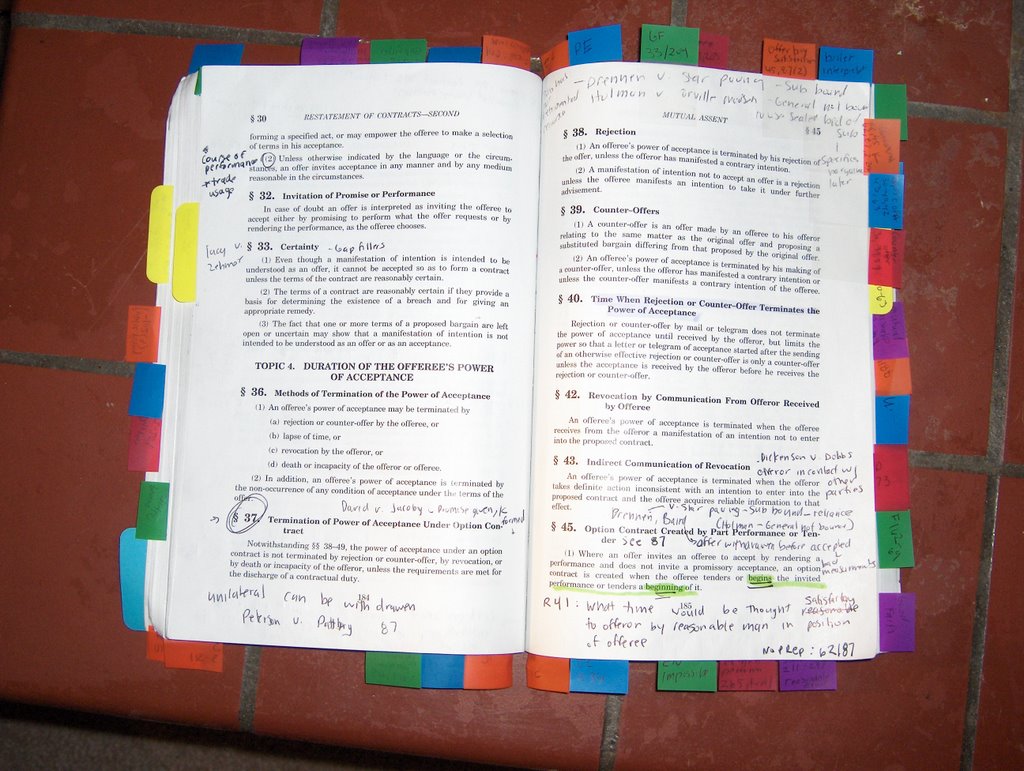
On the eve of the the contract's final, if you don't know a rule, you better know where it is; if you don't know where it is, you better have a tab that does, and; if you don't have a tab, know where to find it, or know it, be able to spot the issue and give a policy answer. There is not much more I can do now. As you can see, my book is fairly thoroughly tabbed, marked up, cross-referenced and I have been through the book several times. It is time to relax, watch a new Grey's Anatomy and de-stress so I can get up fresh in the morning and run through everything before the final at 1:30. I am sure there are students who will be up at the library late into the night, but I am not hoping to get hired an anonymous lawyer's fictional firm (he wouldn't hire me anyway since I don't go to a top 20 school). I hope to work someplace that also allows its employees to maintain a healthy balanced life, and I don't think there is any reason not to apply the same principle to life even now. Enough, time to turn the brain, and the computer off. I'll update after the final.
Saturday, April 29, 2006
Day 3 wrap-up
Right now the UCC is spinning in my head. I hope this is that confusing state right before everything becomes clear because even though I know generally where the provisions are that I might need to interpret a contract and I generally know how they work, once I get in the exam I hope I will be able to pull it together. We have learned many more rules this semester. Last semester we focused on the various theories of obligation and there were nice catagories to place the materials. This semester we covered so many different doctrines--parol evidence, duress, good faith, battle of the forms, accord and satisfaction--and each one has its own provisions in both the UCC and the restatement. The held our hand the first couple of months of last semester, but this semester they have kept the material coming at us and now it is time to see how we did. Our torts professor claimed that by second semester we are not really one-L's any more, but I don't know if that is completely true. It is true in the sense that our professors don't coddel us the way they did at the beginning of the year, but it is not true in the sense that the course of this whole year is to give us the foundation of the law. When I look at the topics that are covered in the bar or come up in cases, we have touched on all of the major doctrines, rules, procedures, etc.. This is what the one-L year seems to be about: the foundation. I am going to bed. I still have 12 more days to keep the stamina up.
Reading (Rainy) Day 3
Today had been the toughest day to keep motivated and there is a sense of closeness (or shall I say doom) to the contracts final. I am completely focused on contracts now and am trying to make sure I understand all of the UCC and Restatement provisions we covered this semester.
The rainy weather is keeping me inside today. I am studying at home mostly for lack of wanting to go outside and secondly because I feel like I have too little time to get all of contracts in my head. I probably shouldn't be blogging, but I just wanted to share the view out the window that I have been looking at most of the day. Rainy days are always bleaker after a week of sunshine. Ahh finals. The stress has finally hit.
Friday, April 28, 2006
Reading Day 2
The nice aspect of finals is that there is a lot of time, because you don’t have to go to class. Of course, much of that time is taken up with studying, but you can schedule it on your own terms. This morning I rode my bike over the top of Capitol Hill to seek out a new coffee shop to studying at. It is nice to be out exploring the city that I have been living in for 8 months but have not really seen, because I have been buried in books. On the other-hand, there is always the risk when going someplace unfamiliar that it will present for you some unforeseen frustration, and although there is time to find a new place, there is not so much time right now to always account for the unpredictable. This new coffee shop, while cute, quaint, and with good organic coffee has “limited or no internet connectivity,” and I can see how this could be good for studying, but I guess I have just come to expect that I will go somewhere and have internet. I am writing this offline and will have to upload it later once I get “connected.”
Today is a torts and property day. They are not coming up until later in the final’s schedule, but it is good to keep them fresh. Plus, Contracts and Civ. Pro. get pretty heavy, so it is good to mix it up.
I’m connected now. So much for studying without distraction. Ha, the internet: American’s greatest resource for distraction.
Today is a torts and property day. They are not coming up until later in the final’s schedule, but it is good to keep them fresh. Plus, Contracts and Civ. Pro. get pretty heavy, so it is good to mix it up.
I’m connected now. So much for studying without distraction. Ha, the internet: American’s greatest resource for distraction.
Thursday, April 27, 2006
Reading Day 1 Wrap-up
It is quarter till midnight and I am currently entering notes from civil procedure into my text book that I can bring into the exam, filling the blank pages with a decision tree for when to apply state or federal procedure and definitions for res judicate and collateral estoppel. It is warm here and I am sitting near the window with a pleasant spring breeze blowing in. This feels so different than the end of last semester. In all my memories of that time it is dark outside and raining and I just remember sitting at my desk for hours staring at the computer and my books. It is nice to be able to get outside in the sun now. I even studied outside at a coffee shop this afternoon and I must say, it was downright pleasant. The public library wasn't bad either, although I did see another law student (can't get away from them completely) and the bathroom was painted a disturbing uniform lime-lime green. There were no more field trips and for the most part it was a nice change of scenery from the law school. I don't know now much more I have in me tonight. I have been distracting by watching Daily Show and Colber report videos. The proportion of distraction to studying is getting larger, which is a good sign I should either study sans computer or go to bed. I'll be back in the morning to give you the outlook for day 2.
Reading Day 1
I decided to spend the morning of my first reading day at the downtown public library. I didn't want to be at home and the thought of being at the law school surrounded by the ambient energy of hundreds of stressed out over-achievers was just to much. I am realizing that the public library is going to have its own hazards. When I walked into the "quiet reading room," which is more like an large open hall on the tenth floor with a great view, it was filled with hords of school children on a field day. Despite their teachers attempts to teach the children about proper library voices, they pretty much saw this place as a new type of playground. There were probably a few that were genuinely interested in the library, but the quiet one's never stand out. This problem, however was easily overcome with a pair of earplugs, and they seem to be filing out of here pretty quickly, which brings us to the second problem: visual noise. Whose idea was it to put purple, red, and turquoise spiriling Pollok-esk carpet in a quiet reading area. They don't make eye-plugs unless you consider burying your noise in the UCC as "eye-plugs" which is what I am going to try and do. I will post again later today with my thoughts on the success on my field trip downtown.
Monday, April 24, 2006
Law Lecture Quotes
Here is another great quote from Contracts class:
"Making a long term fixed price contract is like making an invitation to get sued."
There won't be many more opportunities to follow lectures for gems of legal humor, absurdity, and wisdom, because Wednesday is our last day of classes. I am actually all done with the reading for the semester and turned in my last memo yesterday. All that is left to do is to "bring it all together." I went back and re-read the first case that I read for my first class in law school, Bands Refuse Removal, Inc v. Bourough of Fair Lawn, 62 N.J.Super. 522 (1960), and although I did not have any big epiphanies from having come full circle, I definatly got more out of the case than I did on the first day, much more. I didn't even know that the Federal Rules of Civil Procedure existed and know I can tell you pretty well what most of the rules are. I shouldn't get to excited and reflective yet, because we still have finals to get through, but it does help to see the way all of the law is connected. There are concepts in every case from Civil Procedure, and no substantive area of law is without its crossovers in the others. (Do you have the right on your own property to contract with another to commit a tort?) Bands Refues is an example of judicial power gone bad and I think the editors put it in the casebook first to show us newbies why the courts need rules. After a year of learning these rules, we finished on the the case Hanna v. Plumer, 380 U.S. 460 (1964), and we concluded the study of procedural rules with the words of Justice Warren: "the integrity of the Federal Rules is absolut." So we did go full circle. We need the rules and the rules are absolute. I realize I have completly oversimplified the internal procedural debates that exist in courts and legal scholarship, but this blog has always been about one students first experiences with the laws and I think I can say this: in order to have a functioning legal system there must be a system of rules, and you could complain, for example, that 30 days for filing an appeal is completely arbitrary and justice should not hang on a technicality, but to this I say that if you want to take advantage of the protections of the legal system, you also have to play by its rules. 30 days may be arbitrary, but it is not unfair (I am happily surprised to find the legal system pretty fair, albeit slow. Maybe it is slow because it is fair), and without someone setting the procedural rules, no justice could get handed down.
Back to studying my outlines. I'll be back. . . .
"Making a long term fixed price contract is like making an invitation to get sued."
There won't be many more opportunities to follow lectures for gems of legal humor, absurdity, and wisdom, because Wednesday is our last day of classes. I am actually all done with the reading for the semester and turned in my last memo yesterday. All that is left to do is to "bring it all together." I went back and re-read the first case that I read for my first class in law school, Bands Refuse Removal, Inc v. Bourough of Fair Lawn, 62 N.J.Super. 522 (1960), and although I did not have any big epiphanies from having come full circle, I definatly got more out of the case than I did on the first day, much more. I didn't even know that the Federal Rules of Civil Procedure existed and know I can tell you pretty well what most of the rules are. I shouldn't get to excited and reflective yet, because we still have finals to get through, but it does help to see the way all of the law is connected. There are concepts in every case from Civil Procedure, and no substantive area of law is without its crossovers in the others. (Do you have the right on your own property to contract with another to commit a tort?) Bands Refues is an example of judicial power gone bad and I think the editors put it in the casebook first to show us newbies why the courts need rules. After a year of learning these rules, we finished on the the case Hanna v. Plumer, 380 U.S. 460 (1964), and we concluded the study of procedural rules with the words of Justice Warren: "the integrity of the Federal Rules is absolut." So we did go full circle. We need the rules and the rules are absolute. I realize I have completly oversimplified the internal procedural debates that exist in courts and legal scholarship, but this blog has always been about one students first experiences with the laws and I think I can say this: in order to have a functioning legal system there must be a system of rules, and you could complain, for example, that 30 days for filing an appeal is completely arbitrary and justice should not hang on a technicality, but to this I say that if you want to take advantage of the protections of the legal system, you also have to play by its rules. 30 days may be arbitrary, but it is not unfair (I am happily surprised to find the legal system pretty fair, albeit slow. Maybe it is slow because it is fair), and without someone setting the procedural rules, no justice could get handed down.
Back to studying my outlines. I'll be back. . . .
Friday, April 21, 2006
anonymous no more
I have been reading the Blog "Anonymous Lawyer" for some time now, and even though it is obnoxiously antithetical to so many of my values, I, like many other readers, just kept coming back for more. Although I always new the fictional stories from life of a hiring partner at a large firm were just that, fictional, I guess I assumed that they were simply exagerations of a real hiring partner. The blog does have that simultanious "this can't be real" / "this is how it must be" feeling of one who knows the life intimatly, but recently the author has been outed, and it turns out it is a law student. He is a 3L at Harvard and he doesn't want to be a lawyer. He wants to be a writer. An artist peeking into the law and reflecting its flaws. It will be interesting to see what happens to the blog now that he has been outed in the New York times.
Unpublished Opinions
This is a post that is probably only relevant to those readers who actually work in the legal field or will work in the legal field, but from the perspective of this One-L, the recent decision by the supreme court to allow citations to unpublished opinions seems to be pretty important. One of the frustrating aspects of learning legal writing is that you often come across a case you want to use in your memo only to find out that it is unpublished, thus holding no precedental value, but beginning in January 2007, this will no longer be the case. There is a long running debate, especially in our 9th Circuit about allowing unpublished opinions, because it will mean more work for appellate judges to write unpublished opinions with greater care, but I have come to law school in the era of online technology. We are given passwords to lexis and westlaw (combined wexis) before we even start school and our ability to access unpublished opinions is the same as published, which is one of the main reasons for changing the rules. It is just hard for me to imagine a time when I would have too actually look for cases in books (that would only contain the published opinions). So for me, I have been wondering since I got to law school why we can't just use the unpublished opinions, because this seemed like a logical consclusion of the way legal research is done, and it seems like the supreme court agrees. It is always good when the supreme court makes a decision that you have felt intuitively since starting school would be a good idea. Here is the text of the rule.
Classic Quotes
Another classic quote from law school lectures; this time from contracts:
"Talk about the contract litigation when the apocalypse comes: all the nice people will be gone and the jerks will be left to sue each other."
"Talk about the contract litigation when the apocalypse comes: all the nice people will be gone and the jerks will be left to sue each other."
Subscribe to:
Posts (Atom)
