Supreme Court Sum Up
It definitely feels like summer now. With the Supreme Court wrapping up last friday, I can take a break from following the daily output of 9 old sedentary authorities and follow the turns and twists of 150 sweaty young men. Yes, the Tour de France started on Saturday, and with the top 5 riders from past years out of the race (Lance retired and the next four caught up the the Spanish doping scandal) it proves to be an interesting year for lesser known riders. For those who find watching bike racing to be an increadibly boring and worthless way to spend time, don't forget that following the Supreme Court holds comparitively less excitement, and yet there are those of us that wake up and check the docket like the sports pages to see what opinions have been released. If you are reading this and feeling hopelessly left out because you happened to have missed an entire year of legal opinions from the most important court in the country, there was a wonderful wrap up in this Sunday's Times, including a great many graphs, that summarizes the most important decisions of the year. Roberts is at Court's Helm, but he isn't. . .
As for the tour, because I don't have cable I have to watch it at a bar. Luckily, I just discoverd that the Summit Public House, which is only a couple of blocks from my appartment is legendary for showing the Tour and gathers quite a crowd of bike geeks for the replay at 5:00. It is actually the perfect place. It gets me out of the appartment and has the added bonus that they allow dogs. George has been on his best behavior sitting at the foot of my barstool quietly watching the door and steeling the attention of all of the girls as I watch the tour. He was even rewarded by the barkeep with some leftover bacon, so he probably won't mind going back.
Monday, July 03, 2006

Wednesday, June 28, 2006
Appellate Insults and Legal Payback
Have you ever wondered how appeals court justices insult each other. There is a wonderful example in the concurring opinion by Judge Frank of the Second Circuit in the case between the National Labor Relation Board and Universal Camera Corp. 190 F.2d 429 (2d Cir. 1951). This is actually the second time this case came before this court, the first time only a year earlier. In the meantime, the case moved up to the Supreme Court and was remanded with instructions to reconsider the weight of the conclusions of a special investigator for the NLRB, whose conclusions had previously been overruled by the NLRB's board. The facts of the case are not really important, but it is one of those cases that moves up and down the courts going one way and then the next, and my Admin Law book decided to reprint each of the opinions so that we could see how the case moved around. Judge Learned Hand, who is pictured above in the middle, and who, with a name like Learned Hand, was born to be a judge, wrote both of the appeals court opinions. He is one of those appellate judges, along with Cardozo, pictured left, and Warren, pictured right, whose opinions crop up again and again in first year casebooks. He is also one of the most well renowned and respected justices of American jurisprudence, which you will see when you read the way Judge Frank criticizes his majority opinion; or could Frank's words be just a mask for a scathing in your face appellate insult. This is how Frank's concurring opinion begins:
Recognizing, as only a singularly stupid man would not, Judge Hand's superior wisdom, intelligence and learning, I seldom disagree with him, and then with serious misgivings. In this instance, I have over come my misgivings because I think that his modesty has moved him to interpret too sweepingly the Supreme Court's criticism of our earlier opinion written by him. . .
If this had been a dissent, I think it would fall more to the scathing side; rather, after review Frank's words again, I see here a touch of a type of brilliance that we rarely see in our day to day dealings with the world anymore: the capacity to respectfully disagree. If only we all had the capacity to tell other's they have made a mistake with such craftily constructed phrases and such relationship edifying independence.
On another note, I received my first pay check for doing real legal work. (work study at the library circulation desk doesn't count) After forking over an ungodly amount of money, fronted by banks and the U.S. government, in order to work in this chosen field, I am finally seeing that there is hope of some of that coming back to me. And if I can proceed to earn that money with half the class of Hand and Frank, I think I am going to do alright by the law.
Recognizing, as only a singularly stupid man would not, Judge Hand's superior wisdom, intelligence and learning, I seldom disagree with him, and then with serious misgivings. In this instance, I have over come my misgivings because I think that his modesty has moved him to interpret too sweepingly the Supreme Court's criticism of our earlier opinion written by him. . .
If this had been a dissent, I think it would fall more to the scathing side; rather, after review Frank's words again, I see here a touch of a type of brilliance that we rarely see in our day to day dealings with the world anymore: the capacity to respectfully disagree. If only we all had the capacity to tell other's they have made a mistake with such craftily constructed phrases and such relationship edifying independence.
On another note, I received my first pay check for doing real legal work. (work study at the library circulation desk doesn't count) After forking over an ungodly amount of money, fronted by banks and the U.S. government, in order to work in this chosen field, I am finally seeing that there is hope of some of that coming back to me. And if I can proceed to earn that money with half the class of Hand and Frank, I think I am going to do alright by the law.
Work blogging
I decided to go ahead and write a short post during my lunch break at work. I am not well versed in the standards of internet use at work since this is for all practical purposes my first office job. I think blogging is alright. The other worker monkeys check their e-mail and such and a student I know who works at the State Supreme Court tells me she still floats around myspace while at work.
As I work on these insurance settlement demands, I can't help but wonder how all of these people thought to get a lawyer. If you are hit by an uninsured motorist and you are covered by your own insurance, I would never think to go out and find myself a lawyer. I guess before I came to lawschool I had a pretty negative connotation about suing, such that I never thought I would be in the position to sue someone else. Granted, most of these cases are settled, but there are still lawyers involved. Another reason for my bewilderment at the vast numbers of suits, or potential suits is that I have always had the most minimal of insurance coverage. Maybe when you have very comprehensive insurance, you have a tendency to want to get the most out of it. You are paying higher premiums for something, namely the right to recover "pain and suffering" in the event that you actually file a claim.
Being able to blog at work seems to provide a documentation of the random thoughts I have while reading the files I read. Normally these thoughts would pass throughout the day without ever making their way outside of my mind, but armed with ready internet access and limited in where I can get to during the break, I guess there is not reason not to give them a route out.
As I work on these insurance settlement demands, I can't help but wonder how all of these people thought to get a lawyer. If you are hit by an uninsured motorist and you are covered by your own insurance, I would never think to go out and find myself a lawyer. I guess before I came to lawschool I had a pretty negative connotation about suing, such that I never thought I would be in the position to sue someone else. Granted, most of these cases are settled, but there are still lawyers involved. Another reason for my bewilderment at the vast numbers of suits, or potential suits is that I have always had the most minimal of insurance coverage. Maybe when you have very comprehensive insurance, you have a tendency to want to get the most out of it. You are paying higher premiums for something, namely the right to recover "pain and suffering" in the event that you actually file a claim.
Being able to blog at work seems to provide a documentation of the random thoughts I have while reading the files I read. Normally these thoughts would pass throughout the day without ever making their way outside of my mind, but armed with ready internet access and limited in where I can get to during the break, I guess there is not reason not to give them a route out.
Tuesday, June 20, 2006
short absence
There is probably only a few of you still reading this blog lately because I have been updating so seldonly, and it is not going to get better in the next week. I will be leaving in the morning for Houston to go to a friends wedding, and judging by my previous weeks posting habits, it might be slow around here for a while. After several weeks of having almost nothing to do, things have picked up. I am working, volunteering, and taking a class. Plus, with the summer weather, when I am done with those activities, the last thing I want to do is sit longer at the computer.
This seems to be one of those posts where I return to the theme of blogging itself. I occationally, like many bloggers, feel obligated to reflect on this practice. I was reminded the other day that one of my more egotistically motivated reasons for started to blog was to get more name recognition when self-googling. It seems to have worked. If you googled my name last fall you came up with a listing for a town in India and a manufacturer of helicopter parts. Those listings are still there, but they have been bumped to the second page after a full page of hits that actually point back to me. This has had the added benefit that those who wish to find me can, such as old friends who I have not spoken to in years and whose random e-mail landed in my inbox as a pleasant surprise. All that aside, now that I can be found, I feel somewhat obligated not to disappoint, which means that I do hope to make blogging a more regular practice.
Until then, check out this fun blog that collects gossip about the federal judiciary, Underneath their Robes. Also take a chance to read up on the recent Supreme Court decision that barely held on to the protections of the Clean Water Act. You can read the Kennedy opinion and the Scalia dissent here. That should keep you busy until I get back; it is a 30 page opinion. For myself, I am heading to the the urban wetland of Texas that just this week is receiving a foot of rain a day.
This seems to be one of those posts where I return to the theme of blogging itself. I occationally, like many bloggers, feel obligated to reflect on this practice. I was reminded the other day that one of my more egotistically motivated reasons for started to blog was to get more name recognition when self-googling. It seems to have worked. If you googled my name last fall you came up with a listing for a town in India and a manufacturer of helicopter parts. Those listings are still there, but they have been bumped to the second page after a full page of hits that actually point back to me. This has had the added benefit that those who wish to find me can, such as old friends who I have not spoken to in years and whose random e-mail landed in my inbox as a pleasant surprise. All that aside, now that I can be found, I feel somewhat obligated not to disappoint, which means that I do hope to make blogging a more regular practice.
Until then, check out this fun blog that collects gossip about the federal judiciary, Underneath their Robes. Also take a chance to read up on the recent Supreme Court decision that barely held on to the protections of the Clean Water Act. You can read the Kennedy opinion and the Scalia dissent here. That should keep you busy until I get back; it is a 30 page opinion. For myself, I am heading to the the urban wetland of Texas that just this week is receiving a foot of rain a day.
Wednesday, June 14, 2006
Russkis
Have you ever noticed that certain languages, when you do not understand them, sound, when spoken, as if its speakers are arguing? I am speaking in this instance of of Russian. Did I mention that my legal internship is at a firm run by Russians, with Russian clients, bringing personal injury claims supported by the medical evidence of Russian chiropractors. Please do not construe my tone as indicating any opinions I have formulated about the nature of the work I am doing. I am not sure how much I should discuss my work in this blog, especially since I write under my real name. The real observation I am trying to capture in this post is the sense of how a solo practice law firm is like other small businesses. Families help out, there is a lot of work to be done, and you depend on your community to support you. Except for the fact that I sit in a cubical and work through file after file of settlement demands instead of a small workspace peeling potatoes, it is not all that different than the small restaurants I worked for before coming to law school.
Tuesday, June 13, 2006
The real work of justice: form filling.
I have worked my first day in a real legal office and I have uncovered the real work of justice. From my lowlly position of a back office with cubicles, I have come to see that the real footwork of the law is in filling out forms and in keeping track of lots of paperwork. And what kind of forms will I be spending three days a week filling out. . .settlement demands on behanlf of plaintiffs sent to insurance companies. Yup. . .I am an taking an internship in ambulance chasing and my work life will soon be filled with all sorts of accident reports from fender benders and medical records from chiropractor's offices.
On another note, I was back in the homeless shelter today doing intakes for the social security benefits legal services organization I volunteer for. Our clients are decidedly grateful, but many who are also present in the shelter loath our presence. Part of this is because they are not allowed to smoke during the time when we are in the shelter and the staff makes hourly announcements, by hollering at the top of her voice, that there is "no smoking 'till the lawyer's leave." This is combined with a general distrust of lawyers, or maybe anyone in a position of authority. I am still trying to get comfortable with my future position in life and I am sure I will come up against various attitudes toward lawyers, but I guess few like the one I had today.
After being at the shelter for 3 hours and putting down as many cups of coffee as the schitzoids, I really needed to use the restroom. I figured it was alright, because they always seem to be cleaning around the place. What I didn't realize was that there were no doors on the stalls in the mens restroom. There were several men already in the restroom when I went in to use the urinal. As I went to wash my hands in the sink, an older gentleman sitting on the crapper ostensiably serving nature, and because there were no doors he decided to ask me, "you're a lawyer. . .are you from the IRS?" I assured him that I was not there to discuss his back taxes and quickly made my way out of the restroom.
I think there are three lessons I should take from today's experience. One, when you are homeless, restrooms provide a certain protection from the rest of the world that lend a man the confidence to proffer proclamations from the throne. Two, everyone has an opinion about lawyers. Three, unless you are using your skills to help someone get money/justice, the opinion is just above their opinion toward the IRS.
On another note, I was back in the homeless shelter today doing intakes for the social security benefits legal services organization I volunteer for. Our clients are decidedly grateful, but many who are also present in the shelter loath our presence. Part of this is because they are not allowed to smoke during the time when we are in the shelter and the staff makes hourly announcements, by hollering at the top of her voice, that there is "no smoking 'till the lawyer's leave." This is combined with a general distrust of lawyers, or maybe anyone in a position of authority. I am still trying to get comfortable with my future position in life and I am sure I will come up against various attitudes toward lawyers, but I guess few like the one I had today.
After being at the shelter for 3 hours and putting down as many cups of coffee as the schitzoids, I really needed to use the restroom. I figured it was alright, because they always seem to be cleaning around the place. What I didn't realize was that there were no doors on the stalls in the mens restroom. There were several men already in the restroom when I went in to use the urinal. As I went to wash my hands in the sink, an older gentleman sitting on the crapper ostensiably serving nature, and because there were no doors he decided to ask me, "you're a lawyer. . .are you from the IRS?" I assured him that I was not there to discuss his back taxes and quickly made my way out of the restroom.
I think there are three lessons I should take from today's experience. One, when you are homeless, restrooms provide a certain protection from the rest of the world that lend a man the confidence to proffer proclamations from the throne. Two, everyone has an opinion about lawyers. Three, unless you are using your skills to help someone get money/justice, the opinion is just above their opinion toward the IRS.
Wednesday, June 07, 2006
Not-so-classic lines from law school classes
One of the recurring posts on my One-L blog was a segment called "Classic Lines from Law School Lectures." I hope to continue this tradition during this year. This first post is unfortunately an un-classic line, and it came from a student. I have been shocked at the lack of enthusiasm and participation in my Administrative Law class. Many of the students are night students, and I understand that they work all day and many of them have children and families, but even among the regular students, everyone seems like they are at law school simply as a means to get a job and that speaking is an obligatory burden equal to paying a toll to get across a bridge. There really few "thinkers" at law school, by which I mean individuals who have a genuine interest in delving into the material to absorb it in an authentic way and processing it through their own mind. So many students just want to have the snippets of knowledge handed to them in a linear package so that they can use rote memorization to prepare for the exam. This is not how I have evolved to understand learning or teaching or living, and thus I was shocked at how a Three-L responded to the Professor's request for suggestions on the best way to move through the material (The profession is the Chief Administrative Law Judge in Seattle. He has a lot of real world experience, but he has not taught in a while and is a bit rusty. He has a lot of enthusiasm though, which I enjoy) The student raised his hand and asked: "I am taking this class mostly because I know that administrative law is tested heavily on the bar, so could you maybe focus the class to cover the topics that are going to be covered by the bar exam." I was glad to see that the professor responded with a look of mild shock and disgust and said something like: "I will teach you administrative law and if you learn it, then you will do fine on the exam." The majority of law school students put the cart before the horse. They want to memorize the answer without building the mechanisms to think through the question.
The old fashion way.
As if the world was out to test my new job hunt methods, a day after I sent off my resume in the snail-mail I heard from an employer in Bellevue on the telephone. We did not exchange a single e-mail. There is certainly something to be said for the old fashion ways of communicating.
I also worked my first full day at my volunteer position. I am certainly relieved to know that there are jobs for lawyers where one can wear jeans. I guess that is the advantage of taking on homeless clients. I also enjoyed the work. The other advantage of working at a small non-profit organization is that they gave me quite a bit of responsibility considering I just started. It was nice to feel that my work during school does carry some weight. I have some of my own cases that I will take from intake, through the process, and hopefully through the successful completion of awarding benefits for the clients. I made faxes, I phoned other attorneys, I filled out online applications, and I wrote a client letter. Then I found out that one of my clients was arrested for Burglary II a few hours after I did his intake last week. I spent some time researching the chances of obtaining Social Security benefits with a felony charge, and it looks like he will be spending more time with our friends at the public defender's office than with us.
Tomorrow I think I will, however, wear my suit. I do not know what the dress policy is at this small firm, but I am guessing that it isn't jeans. I think I will stick with the old fashion way.
I also worked my first full day at my volunteer position. I am certainly relieved to know that there are jobs for lawyers where one can wear jeans. I guess that is the advantage of taking on homeless clients. I also enjoyed the work. The other advantage of working at a small non-profit organization is that they gave me quite a bit of responsibility considering I just started. It was nice to feel that my work during school does carry some weight. I have some of my own cases that I will take from intake, through the process, and hopefully through the successful completion of awarding benefits for the clients. I made faxes, I phoned other attorneys, I filled out online applications, and I wrote a client letter. Then I found out that one of my clients was arrested for Burglary II a few hours after I did his intake last week. I spent some time researching the chances of obtaining Social Security benefits with a felony charge, and it looks like he will be spending more time with our friends at the public defender's office than with us.
Tomorrow I think I will, however, wear my suit. I do not know what the dress policy is at this small firm, but I am guessing that it isn't jeans. I think I will stick with the old fashion way.
Tuesday, June 06, 2006
Job Hunt
I have not fulling described the difficulty I have expienced in finding a "law job" this summer beyond the fact that I do not hear back from prospective employers. The fact is that some people have had jobs lined up since sometime last winter, while there are plenty of people who are simply doing what I am doing: taking classes. The seemingly futile attempt to find a job got me down for the last couple of weeks, but I are starting to accept the situation. This does not mean that I am giving up, but rather, I am simply trying to get better. I have never really tried to get a "real job." I have always either been in school or working in non-professional positions, which I use as a term of art, because many of my friends who I worked with at those jobs were doing professional work as theatrical designers, chefs, or arborists to name a few. So when I found two rejection e-mails in my now organized inbox, I took this moment as an opportunity to rejuvinate my job hunt rather than fall into a slump of unemployed rejection. Although, I am trying something new. First, I sent off a hard copy of my cover letter and resume to two new potential employers. I have had such little success with e-mail, I thought I would be better of with hard copies. Then, on Thursday or Friday, I am going to telephone the employers to check up to see that they received my resume. No more waiting around wondering if employers had ever even noticed my e-mails.
In the mean time, I start my second day of voluneering today. I am working with a non-profit law center whose major work consists of helping homeless individuals and families to secure their disability benefits. On my first day I worked with a seventy year old gentleman who I could barely hear and a middle aged man who fought with the CIA in Laos in the 70's. He was 12 and from my understanding, we weren't in Laos. Right? It feels good to actually be doing something in the law. This work is so different from what we learned during our first year, which seems like an abstraction now.
In the mean time, I start my second day of voluneering today. I am working with a non-profit law center whose major work consists of helping homeless individuals and families to secure their disability benefits. On my first day I worked with a seventy year old gentleman who I could barely hear and a middle aged man who fought with the CIA in Laos in the 70's. He was 12 and from my understanding, we weren't in Laos. Right? It feels good to actually be doing something in the law. This work is so different from what we learned during our first year, which seems like an abstraction now.
Wednesday, May 31, 2006
Lost in an Inbox, Part II
As I was thinking about e-mail as a means of communication and why e-mails sometimes get sent off never to be responded to, I noticed how I use e-mail and some of the ways in which I have also been less than perfect in responding to the e-mails that arrive in my inbox. It is true that e-mail is relatively new, a fact spoofed in this weeks Onion in an article talking about uncovering an e-mail artifact from 1995, but there are so many tools available for organizing e-mails and other information that it seems a little strange that we have such a hard time keeping the information organized. I think this is mostly due to lack of understanding. Just as Einstein claimed we only used 10% of our brain, mos uf us use only 10% of the functions available on our computers. So in an attempt to create greater e-mail efficiency in my life, I set out to find the best tools. I found some advise from Richard Kuo's blog on how to manage e-mail effectively. It took me a couple of hours to work through the over 500 e-mails that had amassed in my Inbox since the Christmas Holiday, but the time was well spent. By keeping my inbox basically empty, I can actually deal with the new mail that streams in on a daily basis.
The reason I cam back to this topic is because staying organized is an important skill to develop for aspiring lawyers. Working in the law has a lot to do with the best ways to gather, organize, and process information. In addition, the law has a lot of deadlines, and for some if these deadlines, if you miss them, you can get sued. I went to a talk last semester on "how to prevent malpractice suits." The presenter, I do not remember his name, claimed that if we sat through his hour long talk, he would show us how we can reduce our chances of facing a malpractice suit by 50%. He showed us a lot of statistical data that indicated that half of all malpractice suits are filed because two things that lawyers do wrong: 1. missing an important deadline, such as a statute of limitations, which prevents a client from pursuing an otherwise valid claim; and 2. poor customer relations, where clients feel like their lawyers do not respond to their calls, e-mails, or otherwise stay in communication and keep the case organized. So learning how to organize one's e-mail is an important skill to learn in the age of the technological lawyer.
The reason I cam back to this topic is because staying organized is an important skill to develop for aspiring lawyers. Working in the law has a lot to do with the best ways to gather, organize, and process information. In addition, the law has a lot of deadlines, and for some if these deadlines, if you miss them, you can get sued. I went to a talk last semester on "how to prevent malpractice suits." The presenter, I do not remember his name, claimed that if we sat through his hour long talk, he would show us how we can reduce our chances of facing a malpractice suit by 50%. He showed us a lot of statistical data that indicated that half of all malpractice suits are filed because two things that lawyers do wrong: 1. missing an important deadline, such as a statute of limitations, which prevents a client from pursuing an otherwise valid claim; and 2. poor customer relations, where clients feel like their lawyers do not respond to their calls, e-mails, or otherwise stay in communication and keep the case organized. So learning how to organize one's e-mail is an important skill to learn in the age of the technological lawyer.
Tuesday, May 30, 2006
Its Showtime
I was sitting around watching c-span, as I am sometimes apt to do, and I was drawn in to a fascinating debate going on in a house commitee. Apparently, the Smithsonian, which is partially publically funded and was created as a trust by the congress for the benefit of the people of the United States, (read their history) made some backroom deal with Showtime for a long term, 30 years, contract. All sorts of people are up in arms about this such as independent filmakers, historians, and Congress, because no one asked for their permission. The problem seems to be, besides the fact that this contract was made without congressional oversight, that if a filmaker wants to use the resources of the Smithsonian, they will have to compete with Showtime for the privledge to do so. (More details here) One of the groups that is concerned is PBS. They regularly make use of the Smithsonian archieves, but now, when the Smothsonian is deciding which projects to lend their resources to (this power seems to lie in the hands of the currators), they must decide between PBS, who will make a film for no profit and provide it to the public for free or Showtime, who will share the profits from the film that they show on their on-demand network.
This got me thinking. If we are all the beneficiaries of the Smithsonian trust, have we been taking advantage of the resources of this trust by watching shows on public television? I myself am a regular public radio and television listener/ viewer, but this should not be surprising, since I just admitted I was watching c-span for fun. And I know there are others like me out there. One of the arguments I heard put forward for this deal is that the people who watch public television are already more highly educated and have ready access to educational materials or resources. (This is one of those chicken/ egg questions: is the public television audience more intellegent because they cancelled cabel and watch PBS, or do intellegent people cancel cabel and watch PBS?) The argument would go that if we allow the private sector to produce educational/ historical films using the Smithsonian archeive, they will produce more entertaining and more appealing films that will appeal to an audience that is made up of mostly what I will call Cable Plus individuals (people who not only subsribe to cabel, but also the premium channels). These are entertainment consumers, but by feeding them simply a highly polished Smithsonian production, are we really bringing the trust of American Artifacts and Historical data to the People. I always doubt any project, the purpose of which is to appeal to the masses, and the idea that a private corporation is going to be making a profit off of what belongs essentially to the public trust rubs me the wrong way, even though I can admit the strong argument that such a contract will provide resources to the Smithsonian to fund further projects that would not be possible on its normal budget.
Before I go on too long, I want to add one more thing. One of the side effects of law school is that it gets you to start to look for both sides of an argument. I can see why the Smithsonian thought this was a good deal, but after looking at this issue from that perspective, I return to what my gut tells me. It is just wrong privitise our historical heritage and I have grave doubts about Showtimes production quality, although I am willing to give it a chance to see what they do with it. Cabel has failed. Have you watched a show on the History Channel lately. If you do, does it ever leave you with the feeling that they have the amazing power to produce an hour long show with only about 12 minutes of actual information. I guess that is what happens with commercials, which is the one possible saving grace with Showtime, but cabel is overpriced as it is. Who has an extra $25 a moth to get what belongs to us already.
This got me thinking. If we are all the beneficiaries of the Smithsonian trust, have we been taking advantage of the resources of this trust by watching shows on public television? I myself am a regular public radio and television listener/ viewer, but this should not be surprising, since I just admitted I was watching c-span for fun. And I know there are others like me out there. One of the arguments I heard put forward for this deal is that the people who watch public television are already more highly educated and have ready access to educational materials or resources. (This is one of those chicken/ egg questions: is the public television audience more intellegent because they cancelled cabel and watch PBS, or do intellegent people cancel cabel and watch PBS?) The argument would go that if we allow the private sector to produce educational/ historical films using the Smithsonian archeive, they will produce more entertaining and more appealing films that will appeal to an audience that is made up of mostly what I will call Cable Plus individuals (people who not only subsribe to cabel, but also the premium channels). These are entertainment consumers, but by feeding them simply a highly polished Smithsonian production, are we really bringing the trust of American Artifacts and Historical data to the People. I always doubt any project, the purpose of which is to appeal to the masses, and the idea that a private corporation is going to be making a profit off of what belongs essentially to the public trust rubs me the wrong way, even though I can admit the strong argument that such a contract will provide resources to the Smithsonian to fund further projects that would not be possible on its normal budget.
Before I go on too long, I want to add one more thing. One of the side effects of law school is that it gets you to start to look for both sides of an argument. I can see why the Smithsonian thought this was a good deal, but after looking at this issue from that perspective, I return to what my gut tells me. It is just wrong privitise our historical heritage and I have grave doubts about Showtimes production quality, although I am willing to give it a chance to see what they do with it. Cabel has failed. Have you watched a show on the History Channel lately. If you do, does it ever leave you with the feeling that they have the amazing power to produce an hour long show with only about 12 minutes of actual information. I guess that is what happens with commercials, which is the one possible saving grace with Showtime, but cabel is overpriced as it is. Who has an extra $25 a moth to get what belongs to us already.
Friday, May 26, 2006
Lost in an Inbox
Since I began looking for a legal job for the summer, I have probably sent off about 20 resumes attached to e-mail's as per instructions in the job ad. Each time I send off an e-mail, I also attach anticipation and expectation and what I have learned is a nieve expectation that I will hear anything from the recipiants of my e-mails. Now I understand that no one is just going to hand me a job, and I also understand that these employers are probably receiving many similar resumes and cover letters on top of the rest of their daily e-mail, so I am not really shocked that I have not gotten a job yet, but what I am shocked at is the lack of any type of response, not even a "thank you for your inquiry; we will keep you in mind." or "thank you but not thanks." This is not to say that a few potential employers have not responded. I received one e-mail to tell me that although he was "extremely impressed with my qualifications" he decided to offer the job to another canidate. Although I wondered what it takes to be more than extremely impressing, I did appreciate the response. I also hear back from a professor for a research assistant position, but in my reply concerning my availability for interview times, I have yet to get a confirmation. For the rest of the recipiants, whether professors, private practitioners, non-profit organizations, and temp agencies, I fear my e-mails are buried deep in someone's inbox or spam filter.
I can only guess at the reason for this response, or lack there of. One reason might be that people simply receive too many e-mails. If I consider the number of e-mails I receive on a daily basis and then think about a lawyer with business contacts and professional organization mailings and other reasons to mail, and I can understand that we all get a lot of e-mails, but one of the things I learned last year is that being a lawyer requires attention to detail. You don't just delete an e-mail without reading it. The subject line of my e-mails always indicated the mail's intention, so I assume that the employers receive and have at least glanced at my e-mail. This means that they simply see it as something like junk mail. Is it possible they already have a canidate in mind and posting an add was simply a necissary formality? This might be the case, but how hard would it be to send of a short not to say they received my e-mail but can't offer me an interview? It might also be that they receive multiple e-mails until they see one they like and then call that person, but I would think just as above, a short note would be appropriate? Do these lawyers really have so little time that they can't send of a form e-mail to unsuccessful applicants to a job a job the lawyer has taken the time to post on a law employment website? Such an e-mail would take less than 5 minutes. I don't need anything but we received your e-mail and not thanks?
I realize that one of the classic rules of finding a job is follow up, and this is what I plan on doing today: to go back through my sent e-mail box and find out the status of my application. I have done some of this, and I was again shocked at the number of e-mails it took to even get someone to write me back that they had received my material. This whole process has not left me with a good impression of real legal work, or maybe this is a phenomenon of e-mails. Maybe e-mail is not longer really a valid means of communication? It is quick, efficient, and easy to keep track of, which means that we get a lot of e-mail, but this should also mean it would be increadibly easy to respond. It is a mystery.
I can only guess at the reason for this response, or lack there of. One reason might be that people simply receive too many e-mails. If I consider the number of e-mails I receive on a daily basis and then think about a lawyer with business contacts and professional organization mailings and other reasons to mail, and I can understand that we all get a lot of e-mails, but one of the things I learned last year is that being a lawyer requires attention to detail. You don't just delete an e-mail without reading it. The subject line of my e-mails always indicated the mail's intention, so I assume that the employers receive and have at least glanced at my e-mail. This means that they simply see it as something like junk mail. Is it possible they already have a canidate in mind and posting an add was simply a necissary formality? This might be the case, but how hard would it be to send of a short not to say they received my e-mail but can't offer me an interview? It might also be that they receive multiple e-mails until they see one they like and then call that person, but I would think just as above, a short note would be appropriate? Do these lawyers really have so little time that they can't send of a form e-mail to unsuccessful applicants to a job a job the lawyer has taken the time to post on a law employment website? Such an e-mail would take less than 5 minutes. I don't need anything but we received your e-mail and not thanks?
I realize that one of the classic rules of finding a job is follow up, and this is what I plan on doing today: to go back through my sent e-mail box and find out the status of my application. I have done some of this, and I was again shocked at the number of e-mails it took to even get someone to write me back that they had received my material. This whole process has not left me with a good impression of real legal work, or maybe this is a phenomenon of e-mails. Maybe e-mail is not longer really a valid means of communication? It is quick, efficient, and easy to keep track of, which means that we get a lot of e-mail, but this should also mean it would be increadibly easy to respond. It is a mystery.
Thursday, May 18, 2006
Final Post
I think it is time to wrap up my thoughts about the One-L year and make the move in both my thinking and my blogging toward the next step in this legal journey. I think the One-L year is unique in the way that it takes on legendary proportions. You do not see books written about one's Two-L experience and how transformative it was. Whatever changes are in place for the next year(s), they will, I anticipate, be more internal and will not fit into the tradition of One-L recollections.
I do not feel that this year was especially transformative personally. This might be because I can to lawschool at a relatively older age than many who come either right after college or after working for a year or two. I did learn a lot and I think I know how to process information now better than ever before. I also just have a lot more basic knowledge about the law and government and a bit of society and I experienced all of the stress, confusion, and competitive striving that is a part of the archetypal One-L experience. What I do not feel, however, is that I know any more what it means to be a lawyer. This last year has been a wonderful academic exercise, and that has value to expanding my general knowledge of the world, but I do not really feel any more like a lawyer than I did a year ago. Maybe this is typical as well, and maybe the first year does not really teach what lawyers actually do. I think there is some truth to that, but I have always had a penchant for theory, so I don't really mind. I like learning about history and how the law developed.
Now it is time to get some hands on experience (i.e. a job). It has not proved that easy. I sent out five resumes today and I have already sent out about 10 more. Either there are just so many law students applying for these job that you send of a resume and never hear back or a bunch of gnomes are posting joke job listings just to torment law student with the illusion that we will find work. This hunt for work is going to be a theme of next year's blog law-two-view as well as similar types of thoughts and observations about law school.
One-L. What else to say. I weigh more than I have ever weighed before. You can see it in my belly. It seems to go along with the profession. Even though I worked out more last semester than first semester, I am not as young as I used to be. Sitting around and reading all day is a force, or lack there of, that is hard to fight. It would be interesting to see the collective number of pounds put on by our class. Do we need the extra space to store all that information we learned? There were a few exceptions to the weight gain trend of law school but the overall trend tips the scale of justices.
I must also say, I think I am one of the few poeple who went to law school to make money and ended up feeling a greater obligation to do work for social justice. Most people come to law school with big ideals and hopes to change the world and end up looking for work at a corporate firm because of the financial demands of school debt and the dangling carrot of success offered by the big firm experience. I came to law school with very practical goals and I don't think I have necessarily abandoned my goal of financial security, but a desire to do work that I am passionate about has been awakened. I have always been socially minded and never really motivated by needed a new car and all-inclusive vacations but I think being surrounded by so many career oriented, monotarily motivated individuals has reminded me how little imporance that has had for me in the past. I don't know how why I imagined I would work for some corporate law firm motivated by the bottom line of billable hours. Once I realized this, I have had to adjust how I think about the law and what kind of career oppotunities I will seek out: non-profit? government? non-legal?
Well, this thinking could all be the result of being currently unemployed. I did sent an application to Safco as well as a community housing organization. I do feel like the law has made me more aware of the legal needs of the poor, but I understand that pull toward gainful employment. Ah, this is the real dilemna of the law student.
I am not really sure how to wrap up the One-L year. The conversation is really an on-going one, so look to pick up the thread at the new blog. I will make sure that this blog links there properly.
I do not feel that this year was especially transformative personally. This might be because I can to lawschool at a relatively older age than many who come either right after college or after working for a year or two. I did learn a lot and I think I know how to process information now better than ever before. I also just have a lot more basic knowledge about the law and government and a bit of society and I experienced all of the stress, confusion, and competitive striving that is a part of the archetypal One-L experience. What I do not feel, however, is that I know any more what it means to be a lawyer. This last year has been a wonderful academic exercise, and that has value to expanding my general knowledge of the world, but I do not really feel any more like a lawyer than I did a year ago. Maybe this is typical as well, and maybe the first year does not really teach what lawyers actually do. I think there is some truth to that, but I have always had a penchant for theory, so I don't really mind. I like learning about history and how the law developed.
Now it is time to get some hands on experience (i.e. a job). It has not proved that easy. I sent out five resumes today and I have already sent out about 10 more. Either there are just so many law students applying for these job that you send of a resume and never hear back or a bunch of gnomes are posting joke job listings just to torment law student with the illusion that we will find work. This hunt for work is going to be a theme of next year's blog law-two-view as well as similar types of thoughts and observations about law school.
One-L. What else to say. I weigh more than I have ever weighed before. You can see it in my belly. It seems to go along with the profession. Even though I worked out more last semester than first semester, I am not as young as I used to be. Sitting around and reading all day is a force, or lack there of, that is hard to fight. It would be interesting to see the collective number of pounds put on by our class. Do we need the extra space to store all that information we learned? There were a few exceptions to the weight gain trend of law school but the overall trend tips the scale of justices.
I must also say, I think I am one of the few poeple who went to law school to make money and ended up feeling a greater obligation to do work for social justice. Most people come to law school with big ideals and hopes to change the world and end up looking for work at a corporate firm because of the financial demands of school debt and the dangling carrot of success offered by the big firm experience. I came to law school with very practical goals and I don't think I have necessarily abandoned my goal of financial security, but a desire to do work that I am passionate about has been awakened. I have always been socially minded and never really motivated by needed a new car and all-inclusive vacations but I think being surrounded by so many career oriented, monotarily motivated individuals has reminded me how little imporance that has had for me in the past. I don't know how why I imagined I would work for some corporate law firm motivated by the bottom line of billable hours. Once I realized this, I have had to adjust how I think about the law and what kind of career oppotunities I will seek out: non-profit? government? non-legal?
Well, this thinking could all be the result of being currently unemployed. I did sent an application to Safco as well as a community housing organization. I do feel like the law has made me more aware of the legal needs of the poor, but I understand that pull toward gainful employment. Ah, this is the real dilemna of the law student.
I am not really sure how to wrap up the One-L year. The conversation is really an on-going one, so look to pick up the thread at the new blog. I will make sure that this blog links there properly.
Monday, May 15, 2006
e-mail backed-up
I have spent much of this morning working through the backed up e-mail in my inbox. It is this sort of thing that if you let it get out of control during the semester, you have to spend half a day sorting it out during the break. It is amazing how much e-mail I get, and what is more amazing is that I keep so much of it. When you add the mail from school, the different newsletters I subsribe to, and the notification e-mails from banks and such, your personal mail can get lost. I think some people who havn't heard from me in a while might be getting a word or two in the coming days. I am working in reverse order, so if you wrote in February and I havn't written back, I am sorry, but I don't want to miss the more recent important e-mails, so I think it is best to work in reverse.
Friday, May 12, 2006
Final's hangover
The relief of the end of the semester has been shadowed by a nasty stress hangover. I think I have been carrying the pressure of the last few weeks around without feeling it, but as soon as it was over it all came rushing in. I have had a stomach ache since before the last exam and I have taken a couple of naps today. Basically I am pretty exhausted. It feels like a hangover. Goes to show that stress is a toxin.
The last final was my favorite of them all. One of the questions asked us to write an essay on the way statute and common law bled together and it was fun, as fun as a final can be, to be able to think generally about what law is and the way courts apply the law. Policy is my cup of tea. I want to take the philosophy of law classes and law and literary theater. It is not that I do not enjoy the process of applying law to fact, which most law finals test, but it does not come as naturally to me yet. I have always been plagued by needing to think about "why" things are as they are. How is it that we have decided that we all walk around with a duty to "act reasonably" and that there is an institution that will enforce the breach of this duty. Most studying at law school is not helped by asking such foundational questions. Most tests test your capacity to know which law to apply, and I think this is important, but for me I do not see how to apply law if I do not know where the law came from. I like learning the law through the case law meathod. Of course the board wants to know that we know the black letter law, but I like to see how this developed and why it is that the law changed.
The last final was my favorite of them all. One of the questions asked us to write an essay on the way statute and common law bled together and it was fun, as fun as a final can be, to be able to think generally about what law is and the way courts apply the law. Policy is my cup of tea. I want to take the philosophy of law classes and law and literary theater. It is not that I do not enjoy the process of applying law to fact, which most law finals test, but it does not come as naturally to me yet. I have always been plagued by needing to think about "why" things are as they are. How is it that we have decided that we all walk around with a duty to "act reasonably" and that there is an institution that will enforce the breach of this duty. Most studying at law school is not helped by asking such foundational questions. Most tests test your capacity to know which law to apply, and I think this is important, but for me I do not see how to apply law if I do not know where the law came from. I like learning the law through the case law meathod. Of course the board wants to know that we know the black letter law, but I like to see how this developed and why it is that the law changed.
Thursday, May 11, 2006
Test Day 4: Torts
I woke up feeling sick this morning. I need my body and mind to make it through the rest of today. I think the stress finally is catching up with me. Getting through civ pro was like coming over a false summit, that we knew was false, before having to make the final push to the top of the mountain. Right now I feel like one does when climbing a 14,000 ft. peak. When you get near the top, the air gets thin and you feel exhausted, light headed, and weak from lack of oxygen, but you keep on pushing because you can see the top. I have four hours now to get myself together and run through my torts outline before the exam. Then four hours of exam and One-L will be over.
I do not plan on getting on the computer tonight. Once I get done with the exam I am going to shut it down and take a night off from reading, writing, computering, etc. I will update tomorrow about the final exam and in the next couple of weeks I will be posting some thoughts about this year in general and take some time to look back and think about what has gone on and what it has all meant.
I do not plan on getting on the computer tonight. Once I get done with the exam I am going to shut it down and take a night off from reading, writing, computering, etc. I will update tomorrow about the final exam and in the next couple of weeks I will be posting some thoughts about this year in general and take some time to look back and think about what has gone on and what it has all meant.
Monday, May 08, 2006
Test Day 3: Civil Procedure
This was by far the most brutal and difficult exam of all the law school exams I have taken so far. It was not so much that the fact pattern was complicated with many issues or that it took the entire four hours of steady writing to get everything down on paper but the nature of the exam was exhausting. In contracts or property, we were supposed to describe the parties rights and liabilities. If I was not sure exactly what a court would do or what I would advise a party, I could just write about what both parties to a dispute might have as rights and could move on to the next issue. The civ. pro. exam required us to take a position on the issues and we couldn't hedge our answers. This forced us to decide one way or the other and what made the doubt and necessity to make a decision worse, subsequent issues depended on how we decided earlier issues. Each conclusion of an issue effected how you decided later issues and since it was timed, you could not spend a long time trying to decide which way to play it. It was "an rewarding educational experience" in a way, but it feels like I went running for four hours. It made me think how productive I would be if I could bring some of that same level of focus to studying. You can't function at that level of intensity all the time, but an exam shows you both how well your brain works and where its weaknesses are. Alright, I am not really making any more sense here. Tomorrow I begin to study for torts. Two more reading days and one more final and then a weekend off!!!!!
Sunday, May 07, 2006
Reading Day 9
As I was taking the dog for a walk, I was thinking how nice it would be if when I got home I could have a nice relaxing Sunday evening. The last time I had a Sunday evening with nothing more to do than cook dinner, read a book, and relax was during spring break. I am pretty tired of studying, or maybe I am feeling exhausted because I know that a study free Sunday is only a week away. It is not that law school takes all that much time. I feel like I have more free time now than when I was working in restaurants, and when I am off now, I am not physically exhausted, so I actually have energy to do other things like ride my bike. What makes school so exhausting is that the work is never done. When you want free time you have to demand a space for it from the otherwise filled up schedule.
I worked through all of the rules, statutes, and cases that we have looked at this semester in civil procedure. I enjoyed the material on personal jurisdiction. Maybe because you can really see how common law works. The standard still used today for haling a defendant to court in a distant forum is the minimum contacts test laid out in International Shoe and its progeny. I love the way the courts say "and its progeny" as if the case were a sun surrounded by planets. Murcury would be the cases that most clearly exemplify the holding in International Shoe, whereas a case like Burger King Corp v. Rudzewicz would be somewhere around the Earth's orbit. There are minimum contacts, but there is also some debate, a dissent. When you get to the outer rim cases, the Neptune's, jurisdiction is barely there or maybe only in found to be present by the dissent such was the case in Helicopteros Nacionales de Colombia v. Hall. Of course there are cases that did not make it into the orbital sphere of International Shoe, but this cases surely did not find their way in the case book. For educational purposes, only the close call type of cases or the ones that present a new rule of law are really relevant.
We also studied the planetary sytem of cases surrounding the Erie doctrine and also several cases that dance around the idea of supplimental jurisdiction. These latter cases are orbiting systems around a statute that are held in place by the statutes gravatational pull of authority. The most recent of these was the Exxon Mobil /Rosario v. Star-Kist Foods, Inc case that was published last year and brough together the various standards floating around like stellar particles and formed them into a coherent ruling on the matter of supplimental jurisdiction. For me, it is easier to remember a rule if I can associate the rule with the facts of a specific case, and I think this is one of the main reasons that law school still teaches us the law by having us read cases. Even in areas where the law is governed primarily by statute, no one would want to go to law school or teach at one if learning was simply a matter of memorizing rules. Rules are developed from facts and are then re-applied to new facts. If I have learned anything this year, it is that the law is a continuous dialogue between rules and facts, each one affecting the other and dependent on the other for any coherent legal meaning. We study the facts of cases so we can learn the law and we learn the law so that we can apply it to new facts, and when no law can be rightly applied to a new set of facts, those facts can move through the legal system changing the law so that the law reflects what is the just outcome in a particular set of facts. This new law will then be applied to the subsequent facts that come into the courts, and on and on and on.
I worked through all of the rules, statutes, and cases that we have looked at this semester in civil procedure. I enjoyed the material on personal jurisdiction. Maybe because you can really see how common law works. The standard still used today for haling a defendant to court in a distant forum is the minimum contacts test laid out in International Shoe and its progeny. I love the way the courts say "and its progeny" as if the case were a sun surrounded by planets. Murcury would be the cases that most clearly exemplify the holding in International Shoe, whereas a case like Burger King Corp v. Rudzewicz would be somewhere around the Earth's orbit. There are minimum contacts, but there is also some debate, a dissent. When you get to the outer rim cases, the Neptune's, jurisdiction is barely there or maybe only in found to be present by the dissent such was the case in Helicopteros Nacionales de Colombia v. Hall. Of course there are cases that did not make it into the orbital sphere of International Shoe, but this cases surely did not find their way in the case book. For educational purposes, only the close call type of cases or the ones that present a new rule of law are really relevant.
We also studied the planetary sytem of cases surrounding the Erie doctrine and also several cases that dance around the idea of supplimental jurisdiction. These latter cases are orbiting systems around a statute that are held in place by the statutes gravatational pull of authority. The most recent of these was the Exxon Mobil /Rosario v. Star-Kist Foods, Inc case that was published last year and brough together the various standards floating around like stellar particles and formed them into a coherent ruling on the matter of supplimental jurisdiction. For me, it is easier to remember a rule if I can associate the rule with the facts of a specific case, and I think this is one of the main reasons that law school still teaches us the law by having us read cases. Even in areas where the law is governed primarily by statute, no one would want to go to law school or teach at one if learning was simply a matter of memorizing rules. Rules are developed from facts and are then re-applied to new facts. If I have learned anything this year, it is that the law is a continuous dialogue between rules and facts, each one affecting the other and dependent on the other for any coherent legal meaning. We study the facts of cases so we can learn the law and we learn the law so that we can apply it to new facts, and when no law can be rightly applied to a new set of facts, those facts can move through the legal system changing the law so that the law reflects what is the just outcome in a particular set of facts. This new law will then be applied to the subsequent facts that come into the courts, and on and on and on.
Saturday, May 06, 2006
Reading Days 7 and 8
There is an interesting debate going on on Ann Althouse's blog about whether students believe that professors use the final exam as a rewarding educational experience. I found my way to her blog when I heard her speak on the public radio program Open Source. The topic of the show was Steven Colbert's hilarious and powerful performance last saturday at the white house press core dinner. I pretty much didn't agree with anything she had to say, so I wanted to check out her widely read blog to see what she is about. Lo and behold, she is a law professor, and although I continued to find little to agree with after reading some of her posts, I do think that there is some rewarding educational experience from taking a final. As I think I said in an earler post, the final is about the only time in the course of the semester that you get to see how all of the material you have learned comes together. The topics are no longer isolated into neat units that can be broken down to managable reading assignments and 50 minute lecturs. I think there is something rewarding about making connections and seeing pieces of a puzzel fit together. However, I do not think most students see it this way. One commentor cynically noted that most students just see law school as a means to a high paying job and the only thing rewarding about the exams is that they are necessary to purchase a nice car. I would, however, that even if many students are motivated by money, they realize that they have to get a good grade to get a good job, so much of their thoughts surrounding the exam are simple on getting a good grade. I believe students are focused on getting done with the best possible results than they are on the actual experience of the exam. Especially this semester, students seem to see each exam as one less barrier to some imagined summertime freedom.
I have made a personal commitment to not talk with other students about the exam after it is over, except very generally, so I can't really say how their experience the exam. I do this for my own sanity and because once you finish one exam, unless it is the last, there is still more studying to be done, and when you talk to another student about the contents of their exam, inevitably they will have seen something that you did not see. This kind of exchange can only lead to the feeling that you did not stack up to the other students, and even if you spotted 8 issues that the other student did not see, you are going to think about the one you missed. Therefore, if there is a rewarding educational experience, it is wholly personal and I don't think it is reflected so much in the grades, and because law students are cut from an especially competitive and over-achieving cloth, grades get a lot of the focus of many law students minds, even if they will become wholly irrelavant three years down the road.
I am in the middle of a three day civil cram-it-in-the-brain procedure. This material is definatly more engaging than easements. The weather has turned cloudy again, and I am grateful.
I have made a personal commitment to not talk with other students about the exam after it is over, except very generally, so I can't really say how their experience the exam. I do this for my own sanity and because once you finish one exam, unless it is the last, there is still more studying to be done, and when you talk to another student about the contents of their exam, inevitably they will have seen something that you did not see. This kind of exchange can only lead to the feeling that you did not stack up to the other students, and even if you spotted 8 issues that the other student did not see, you are going to think about the one you missed. Therefore, if there is a rewarding educational experience, it is wholly personal and I don't think it is reflected so much in the grades, and because law students are cut from an especially competitive and over-achieving cloth, grades get a lot of the focus of many law students minds, even if they will become wholly irrelavant three years down the road.
I am in the middle of a three day civil cram-it-in-the-brain procedure. This material is definatly more engaging than easements. The weather has turned cloudy again, and I am grateful.
Thursday, May 04, 2006
Test Day 2: property
Half way through this two week battle that we have been preparing for since January, but there is still a substantial number of struggles left. As a friend told me today after our property final, this is like a marathon: you are half way over at mile 20. I was loosing some steam the last couple of days, but I feel energized for civil procedure on monday. I never could get excited about property. Easements and covenants just did not get me excited to want to learn the material, but I have enjoyed the topics in civil procedure this semester. Jurisdiction and choice of law and appeals touched on that philosophical part of my brain that the policies around "touch and concern" just could not, well, touch and concern. Whatever it is I'll take it. I think that is a sign I am going to like constitutional law and evidence (things to look forward to.) Tonight I have some simple plans: vacuum, dishes, clean the misc. papers off the desk , and some t.v.. And what does a law student with a philosophical bent in the middle of finals watch: American Inventor. This show could make any steely eyed cynic cry. It is a blatent television manipulation. I do think these inventors are passionate, but the way the television edits out all of their hours of boring and mudane hard work and only shows their break downs and moments of inspiration makes it for emotional tv. I guess most things are not like tv. Lots of long mundane work for a few minutes of excitement. Sounds like finals, if you can call them excitement.
Wednesday, May 03, 2006
Reading Days 5 and 6
Two days to read for property, or rather, two days to learn property. Not a whole lot to report right now. I spent most of yesterday reviewing outlines and taking computerized "cali" lessons about the property material from the semester. Even though I have the feeling I didn't learn any of this stuff until yesterday, it wasn't completely foriegn, which goes to show that just being in class and doing the reading is sometimes enough. Today, I am taking practice exams. Preparing, or learning in general seems to have both a passive and an active aspect. The passive aspect is when you are reading your notes, or a case, or an outline to trying and comprehend the material. The active aspect is when you are faced with a series of facts and you have to apply the material you passively comprehended. The active learning requires much more focus, but it is the kind of focus that is required in the exam. When faced with motavating for an active exam preparation exercise, I always have some internal hesitation. It kind of hurts in the same way the first five minutes of a long bike rike hurts because your musceles are not ready to move, but once you get into it, it feels pretty good. There is something pleasureable about applying law to fact. It is the same part of the brain that is stimulated by puzzles or word games. Without taking at least some pleasure in this kind of work, law school would be a real drag.
Nice weather today. I might get out for a bike ride this afternoon. I took a couple hours off yesterday and went downtown to the pike market and had lunch with my girlfriend at Cafe Campagne. It was the perfect way for us to take a break from the books and stay fresh. It is important to keep perspective on life even during finals. We still have 8 days of reading and taking finals, and the last one counts just as much as the first one. A happy brain is a relaxed brain (not too relaxed, this isn't vacation). Again, just like biking, if you relax your upper body, your legs become more efficient. Ok, on to practice exams.
Nice weather today. I might get out for a bike ride this afternoon. I took a couple hours off yesterday and went downtown to the pike market and had lunch with my girlfriend at Cafe Campagne. It was the perfect way for us to take a break from the books and stay fresh. It is important to keep perspective on life even during finals. We still have 8 days of reading and taking finals, and the last one counts just as much as the first one. A happy brain is a relaxed brain (not too relaxed, this isn't vacation). Again, just like biking, if you relax your upper body, your legs become more efficient. Ok, on to practice exams.
Monday, May 01, 2006
Test Day 1: contracts
The thing you realize every time you take a final is that you learned way more than any three hour final can ever test you on. The reason you have to learn all that stuff is that you never know exactly what will be in those three hours. The other thing you realize is how much energy it takes to think about this stuff in an intense setting, but in a way, finals are kind of fun. They are like a game where you get to show off as much of the stuff you learned as you can.
I really can't think very well tonight. I have been trying to rest my brain for tomorrow. I have two day to learn everything we convered in property this semester. We didn't cover that much: Landlord / Tenat duties, covenants, and easements, so I think I can do it. I felt pretty good about todays final, but I did not really talk to anyone else about it (purposefully) so I can't really say how I compared, and none of us will really know till the grades come back.
I am sorry for the disorganized mess of this post. Tonight is a night off from clear thinking. I'll be back tomorrow. I hope
I really can't think very well tonight. I have been trying to rest my brain for tomorrow. I have two day to learn everything we convered in property this semester. We didn't cover that much: Landlord / Tenat duties, covenants, and easements, so I think I can do it. I felt pretty good about todays final, but I did not really talk to anyone else about it (purposefully) so I can't really say how I compared, and none of us will really know till the grades come back.
I am sorry for the disorganized mess of this post. Tonight is a night off from clear thinking. I'll be back tomorrow. I hope
Sunday, April 30, 2006
Reading day 4
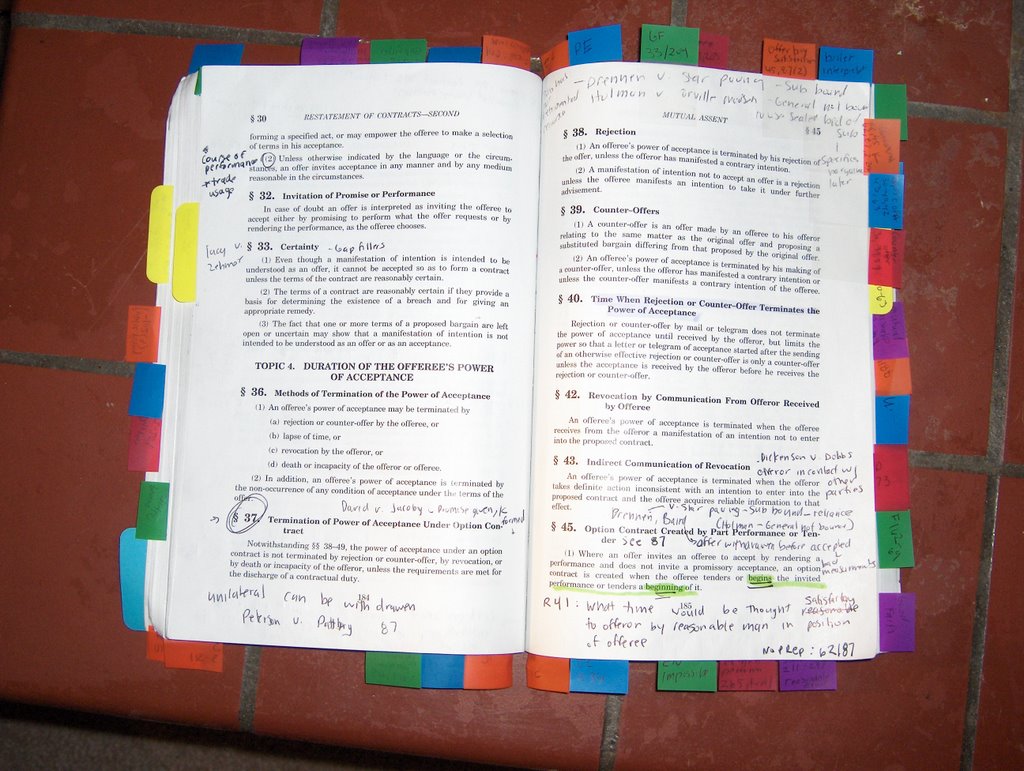
On the eve of the the contract's final, if you don't know a rule, you better know where it is; if you don't know where it is, you better have a tab that does, and; if you don't have a tab, know where to find it, or know it, be able to spot the issue and give a policy answer. There is not much more I can do now. As you can see, my book is fairly thoroughly tabbed, marked up, cross-referenced and I have been through the book several times. It is time to relax, watch a new Grey's Anatomy and de-stress so I can get up fresh in the morning and run through everything before the final at 1:30. I am sure there are students who will be up at the library late into the night, but I am not hoping to get hired an anonymous lawyer's fictional firm (he wouldn't hire me anyway since I don't go to a top 20 school). I hope to work someplace that also allows its employees to maintain a healthy balanced life, and I don't think there is any reason not to apply the same principle to life even now. Enough, time to turn the brain, and the computer off. I'll update after the final.
Saturday, April 29, 2006
Day 3 wrap-up
Right now the UCC is spinning in my head. I hope this is that confusing state right before everything becomes clear because even though I know generally where the provisions are that I might need to interpret a contract and I generally know how they work, once I get in the exam I hope I will be able to pull it together. We have learned many more rules this semester. Last semester we focused on the various theories of obligation and there were nice catagories to place the materials. This semester we covered so many different doctrines--parol evidence, duress, good faith, battle of the forms, accord and satisfaction--and each one has its own provisions in both the UCC and the restatement. The held our hand the first couple of months of last semester, but this semester they have kept the material coming at us and now it is time to see how we did. Our torts professor claimed that by second semester we are not really one-L's any more, but I don't know if that is completely true. It is true in the sense that our professors don't coddel us the way they did at the beginning of the year, but it is not true in the sense that the course of this whole year is to give us the foundation of the law. When I look at the topics that are covered in the bar or come up in cases, we have touched on all of the major doctrines, rules, procedures, etc.. This is what the one-L year seems to be about: the foundation. I am going to bed. I still have 12 more days to keep the stamina up.
Reading (Rainy) Day 3
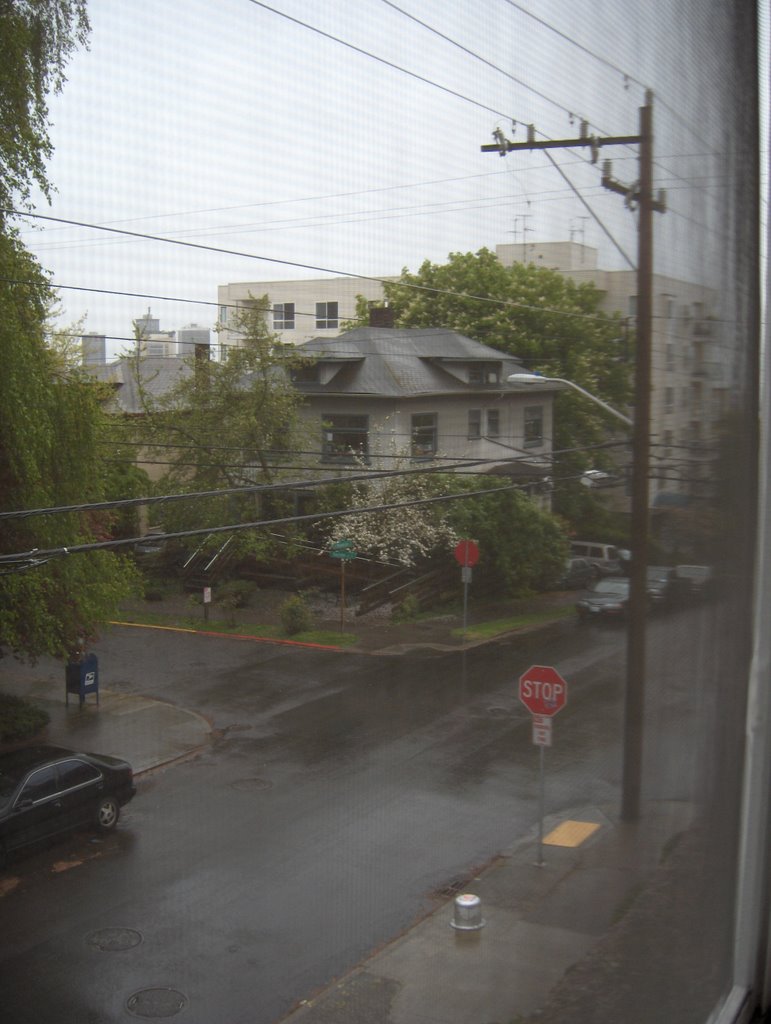
Today had been the toughest day to keep motivated and there is a sense of closeness (or shall I say doom) to the contracts final. I am completely focused on contracts now and am trying to make sure I understand all of the UCC and Restatement provisions we covered this semester.
The rainy weather is keeping me inside today. I am studying at home mostly for lack of wanting to go outside and secondly because I feel like I have too little time to get all of contracts in my head. I probably shouldn't be blogging, but I just wanted to share the view out the window that I have been looking at most of the day. Rainy days are always bleaker after a week of sunshine. Ahh finals. The stress has finally hit.
Friday, April 28, 2006
Reading Day 2
The nice aspect of finals is that there is a lot of time, because you don’t have to go to class. Of course, much of that time is taken up with studying, but you can schedule it on your own terms. This morning I rode my bike over the top of Capitol Hill to seek out a new coffee shop to studying at. It is nice to be out exploring the city that I have been living in for 8 months but have not really seen, because I have been buried in books. On the other-hand, there is always the risk when going someplace unfamiliar that it will present for you some unforeseen frustration, and although there is time to find a new place, there is not so much time right now to always account for the unpredictable. This new coffee shop, while cute, quaint, and with good organic coffee has “limited or no internet connectivity,” and I can see how this could be good for studying, but I guess I have just come to expect that I will go somewhere and have internet. I am writing this offline and will have to upload it later once I get “connected.”
Today is a torts and property day. They are not coming up until later in the final’s schedule, but it is good to keep them fresh. Plus, Contracts and Civ. Pro. get pretty heavy, so it is good to mix it up.
I’m connected now. So much for studying without distraction. Ha, the internet: American’s greatest resource for distraction.
Today is a torts and property day. They are not coming up until later in the final’s schedule, but it is good to keep them fresh. Plus, Contracts and Civ. Pro. get pretty heavy, so it is good to mix it up.
I’m connected now. So much for studying without distraction. Ha, the internet: American’s greatest resource for distraction.
Thursday, April 27, 2006
Reading Day 1 Wrap-up
It is quarter till midnight and I am currently entering notes from civil procedure into my text book that I can bring into the exam, filling the blank pages with a decision tree for when to apply state or federal procedure and definitions for res judicate and collateral estoppel. It is warm here and I am sitting near the window with a pleasant spring breeze blowing in. This feels so different than the end of last semester. In all my memories of that time it is dark outside and raining and I just remember sitting at my desk for hours staring at the computer and my books. It is nice to be able to get outside in the sun now. I even studied outside at a coffee shop this afternoon and I must say, it was downright pleasant. The public library wasn't bad either, although I did see another law student (can't get away from them completely) and the bathroom was painted a disturbing uniform lime-lime green. There were no more field trips and for the most part it was a nice change of scenery from the law school. I don't know now much more I have in me tonight. I have been distracting by watching Daily Show and Colber report videos. The proportion of distraction to studying is getting larger, which is a good sign I should either study sans computer or go to bed. I'll be back in the morning to give you the outlook for day 2.
Reading Day 1
I decided to spend the morning of my first reading day at the downtown public library. I didn't want to be at home and the thought of being at the law school surrounded by the ambient energy of hundreds of stressed out over-achievers was just to much. I am realizing that the public library is going to have its own hazards. When I walked into the "quiet reading room," which is more like an large open hall on the tenth floor with a great view, it was filled with hords of school children on a field day. Despite their teachers attempts to teach the children about proper library voices, they pretty much saw this place as a new type of playground. There were probably a few that were genuinely interested in the library, but the quiet one's never stand out. This problem, however was easily overcome with a pair of earplugs, and they seem to be filing out of here pretty quickly, which brings us to the second problem: visual noise. Whose idea was it to put purple, red, and turquoise spiriling Pollok-esk carpet in a quiet reading area. They don't make eye-plugs unless you consider burying your noise in the UCC as "eye-plugs" which is what I am going to try and do. I will post again later today with my thoughts on the success on my field trip downtown.
Monday, April 24, 2006
Law Lecture Quotes
Here is another great quote from Contracts class:
"Making a long term fixed price contract is like making an invitation to get sued."
There won't be many more opportunities to follow lectures for gems of legal humor, absurdity, and wisdom, because Wednesday is our last day of classes. I am actually all done with the reading for the semester and turned in my last memo yesterday. All that is left to do is to "bring it all together." I went back and re-read the first case that I read for my first class in law school, Bands Refuse Removal, Inc v. Bourough of Fair Lawn, 62 N.J.Super. 522 (1960), and although I did not have any big epiphanies from having come full circle, I definatly got more out of the case than I did on the first day, much more. I didn't even know that the Federal Rules of Civil Procedure existed and know I can tell you pretty well what most of the rules are. I shouldn't get to excited and reflective yet, because we still have finals to get through, but it does help to see the way all of the law is connected. There are concepts in every case from Civil Procedure, and no substantive area of law is without its crossovers in the others. (Do you have the right on your own property to contract with another to commit a tort?) Bands Refues is an example of judicial power gone bad and I think the editors put it in the casebook first to show us newbies why the courts need rules. After a year of learning these rules, we finished on the the case Hanna v. Plumer, 380 U.S. 460 (1964), and we concluded the study of procedural rules with the words of Justice Warren: "the integrity of the Federal Rules is absolut." So we did go full circle. We need the rules and the rules are absolute. I realize I have completly oversimplified the internal procedural debates that exist in courts and legal scholarship, but this blog has always been about one students first experiences with the laws and I think I can say this: in order to have a functioning legal system there must be a system of rules, and you could complain, for example, that 30 days for filing an appeal is completely arbitrary and justice should not hang on a technicality, but to this I say that if you want to take advantage of the protections of the legal system, you also have to play by its rules. 30 days may be arbitrary, but it is not unfair (I am happily surprised to find the legal system pretty fair, albeit slow. Maybe it is slow because it is fair), and without someone setting the procedural rules, no justice could get handed down.
Back to studying my outlines. I'll be back. . . .
"Making a long term fixed price contract is like making an invitation to get sued."
There won't be many more opportunities to follow lectures for gems of legal humor, absurdity, and wisdom, because Wednesday is our last day of classes. I am actually all done with the reading for the semester and turned in my last memo yesterday. All that is left to do is to "bring it all together." I went back and re-read the first case that I read for my first class in law school, Bands Refuse Removal, Inc v. Bourough of Fair Lawn, 62 N.J.Super. 522 (1960), and although I did not have any big epiphanies from having come full circle, I definatly got more out of the case than I did on the first day, much more. I didn't even know that the Federal Rules of Civil Procedure existed and know I can tell you pretty well what most of the rules are. I shouldn't get to excited and reflective yet, because we still have finals to get through, but it does help to see the way all of the law is connected. There are concepts in every case from Civil Procedure, and no substantive area of law is without its crossovers in the others. (Do you have the right on your own property to contract with another to commit a tort?) Bands Refues is an example of judicial power gone bad and I think the editors put it in the casebook first to show us newbies why the courts need rules. After a year of learning these rules, we finished on the the case Hanna v. Plumer, 380 U.S. 460 (1964), and we concluded the study of procedural rules with the words of Justice Warren: "the integrity of the Federal Rules is absolut." So we did go full circle. We need the rules and the rules are absolute. I realize I have completly oversimplified the internal procedural debates that exist in courts and legal scholarship, but this blog has always been about one students first experiences with the laws and I think I can say this: in order to have a functioning legal system there must be a system of rules, and you could complain, for example, that 30 days for filing an appeal is completely arbitrary and justice should not hang on a technicality, but to this I say that if you want to take advantage of the protections of the legal system, you also have to play by its rules. 30 days may be arbitrary, but it is not unfair (I am happily surprised to find the legal system pretty fair, albeit slow. Maybe it is slow because it is fair), and without someone setting the procedural rules, no justice could get handed down.
Back to studying my outlines. I'll be back. . . .
Friday, April 21, 2006
anonymous no more
I have been reading the Blog "Anonymous Lawyer" for some time now, and even though it is obnoxiously antithetical to so many of my values, I, like many other readers, just kept coming back for more. Although I always new the fictional stories from life of a hiring partner at a large firm were just that, fictional, I guess I assumed that they were simply exagerations of a real hiring partner. The blog does have that simultanious "this can't be real" / "this is how it must be" feeling of one who knows the life intimatly, but recently the author has been outed, and it turns out it is a law student. He is a 3L at Harvard and he doesn't want to be a lawyer. He wants to be a writer. An artist peeking into the law and reflecting its flaws. It will be interesting to see what happens to the blog now that he has been outed in the New York times.
Unpublished Opinions
This is a post that is probably only relevant to those readers who actually work in the legal field or will work in the legal field, but from the perspective of this One-L, the recent decision by the supreme court to allow citations to unpublished opinions seems to be pretty important. One of the frustrating aspects of learning legal writing is that you often come across a case you want to use in your memo only to find out that it is unpublished, thus holding no precedental value, but beginning in January 2007, this will no longer be the case. There is a long running debate, especially in our 9th Circuit about allowing unpublished opinions, because it will mean more work for appellate judges to write unpublished opinions with greater care, but I have come to law school in the era of online technology. We are given passwords to lexis and westlaw (combined wexis) before we even start school and our ability to access unpublished opinions is the same as published, which is one of the main reasons for changing the rules. It is just hard for me to imagine a time when I would have too actually look for cases in books (that would only contain the published opinions). So for me, I have been wondering since I got to law school why we can't just use the unpublished opinions, because this seemed like a logical consclusion of the way legal research is done, and it seems like the supreme court agrees. It is always good when the supreme court makes a decision that you have felt intuitively since starting school would be a good idea. Here is the text of the rule.
Classic Quotes
Another classic quote from law school lectures; this time from contracts:
"Talk about the contract litigation when the apocalypse comes: all the nice people will be gone and the jerks will be left to sue each other."
"Talk about the contract litigation when the apocalypse comes: all the nice people will be gone and the jerks will be left to sue each other."
Thursday, April 20, 2006
Moot Court Wrap Up
I have somewhat of a shorter entry this week and it is coming a bit later (it is a three-day weekend). I hope to bring back some deeper analysis next week, but on re-reading this, I think there is some worth in these late at night ramblings.
I. Case of the Week:
As I think back to this week, no case stands out as particularly interesting. I know I said I was going to talk about easements, but for some reason I just can’t get excited about disputes between parties pertaining to who has a right to the underground sewer pipes. In the words of our property Professor, “when you buy a house with plumbing, you believe that the effluent (this was his word and I have not yet figured out if this is the proper legal term or just how he describes the contents of sewers) must be able to go somewhere,” but just like the situation in that case, my Property (reading) is backed up and unknowingly filling the basement of my mind. In case you have not figured it out by reading these ramblings, let this be a reminder that I am full of s*#t. The reason for lack of preparedness (I still at least read all of the cases, unlike some of the students in our section [see last weeks post on passing in class]) was because I was working on our case for the moot court competition. Between getting all dressed up in my suit and standing in front of a panel of “mock judges” and a altogether independent presentation in our legal writing class called “senior partner meetings,” where a group of us associates in training presented legal research to the “senior partner,” I almost felt like a lawyer. My partner in the moot court competition even gave me a yellow legal pad before we had our day in court, but let us not get ahead of ourselves. Before my ego gets completely out of control, I must remember that my legal understanding is still trailing behind the costume, and there is still a lot to learn before anyone should trust me with their legal affairs, but that is what this is all about—this law school experience that still feels so new—and this was certainly a week were I felt first how far I have come along and secondly, how far I still have to go.
First, how far I have come: in preparing for moot court, I wrote an opening statement, I prepared a witness, I wrote questions for direct, I prepared questions for cross, and then I gave my open, directed my witness, crossed the opposing witness and objected to the other sides questions. I had no idea what I was doing. My understanding of litigation is entirely based on David Kelly and Law and Order, but somehow the “thinking like a lawyer” that our professors talked about so much at the beginning of the year has begun to pervade my thoughts, because in the midst of this exercise (completely hypothetical) I really began to believe our arguments. I believed in our case whole heartedly, and I felt what it might be like to make arguments for your client because you believe that they have rights.
Second, how far I must go: this is a summation of the advice given to me from the panel of judges: Look at the judges. It is important to make eye contact. This goes together with not using your notes too much. I used my notes as a crutch and know that I could have directed my client without them, but thus far my law experience has been all on paper, so it was difficult to stand up and intuitively react to a “legal situation.” Next, I told a story in my opening argument, but I also needed to outline the law that we were going to use and ask the judges to apply to the facts we were going to show in our “story.” There was a lot more, but one of the judges gave the advice that we shouldn’t think too much about this stuff. It was our first opportunity to get involved with litigation and we will have a lot of time to build on the experience.
II. At Lawge
Since I have been pretty involved in the moot court this week, I really have not kept up with the legal word outside of law school, but if you really need to see how the law applies to our everyday life, just go to any newspaper website and type in the words law, legal, court, etc. and you will get some story. I hate to disappoint my readers, all 3 of you, but this is going to be a short post this week. Don’t worry though. It is getting cloudy in Seattle again so it will be a lot easier to sit at the computer and write blog posts than it was in the last week of clear skies and sun.
III. Gossip Column
I have to say I was pretty impressed with the attitude of those fellow moot court participants. Everyone took it seriously, but from what I saw no one took it so seriously that they were not cordial with the other competitors. Even though there were six winners from 40, most of us were there just to improve our skills at lawyering. And for those who won, well, there were not real surprises. There are some people whose charisma and seemingly perpetual preparedness seem to just put them one step ahead of the curve and if the rest of use can put our egos aside for a minute, we can enjoy studying with these colleges. There are a few students, not the brightest, who seem unable to do this. They relate to this whole experience as a competition with the rest of the students and not as a collaborative learning experience. I understand that we have an “adversarial system,” but outside of the courtroom we are all trying to become the best lawyers we can be, or at least that is the ideal that I strive for. It is for this reason that I do not tell my grade to anyone, and I do not ask for anyone’s grades. I also try and compliment those students who do well in class, and for those who bomb, well, I will make fun of their ignorance on this blog.
IV. Judicial quote
I think this quote accurately describes how I felt about my mock court experience:
"I used to say that, as Solicitor General, I made three arguments of every case. First came the one that I planned--as I thought, logical, coherent, complete. Second was the one actually presented--interrupted, incoherent, disjointed, disappointing. The third was the utterly devastating argument that I thought of after going to bed that night."
-Robert H. Jackson, Advocacy Before the Supreme Court (1951)
I. Case of the Week:
As I think back to this week, no case stands out as particularly interesting. I know I said I was going to talk about easements, but for some reason I just can’t get excited about disputes between parties pertaining to who has a right to the underground sewer pipes. In the words of our property Professor, “when you buy a house with plumbing, you believe that the effluent (this was his word and I have not yet figured out if this is the proper legal term or just how he describes the contents of sewers) must be able to go somewhere,” but just like the situation in that case, my Property (reading) is backed up and unknowingly filling the basement of my mind. In case you have not figured it out by reading these ramblings, let this be a reminder that I am full of s*#t. The reason for lack of preparedness (I still at least read all of the cases, unlike some of the students in our section [see last weeks post on passing in class]) was because I was working on our case for the moot court competition. Between getting all dressed up in my suit and standing in front of a panel of “mock judges” and a altogether independent presentation in our legal writing class called “senior partner meetings,” where a group of us associates in training presented legal research to the “senior partner,” I almost felt like a lawyer. My partner in the moot court competition even gave me a yellow legal pad before we had our day in court, but let us not get ahead of ourselves. Before my ego gets completely out of control, I must remember that my legal understanding is still trailing behind the costume, and there is still a lot to learn before anyone should trust me with their legal affairs, but that is what this is all about—this law school experience that still feels so new—and this was certainly a week were I felt first how far I have come along and secondly, how far I still have to go.
First, how far I have come: in preparing for moot court, I wrote an opening statement, I prepared a witness, I wrote questions for direct, I prepared questions for cross, and then I gave my open, directed my witness, crossed the opposing witness and objected to the other sides questions. I had no idea what I was doing. My understanding of litigation is entirely based on David Kelly and Law and Order, but somehow the “thinking like a lawyer” that our professors talked about so much at the beginning of the year has begun to pervade my thoughts, because in the midst of this exercise (completely hypothetical) I really began to believe our arguments. I believed in our case whole heartedly, and I felt what it might be like to make arguments for your client because you believe that they have rights.
Second, how far I must go: this is a summation of the advice given to me from the panel of judges: Look at the judges. It is important to make eye contact. This goes together with not using your notes too much. I used my notes as a crutch and know that I could have directed my client without them, but thus far my law experience has been all on paper, so it was difficult to stand up and intuitively react to a “legal situation.” Next, I told a story in my opening argument, but I also needed to outline the law that we were going to use and ask the judges to apply to the facts we were going to show in our “story.” There was a lot more, but one of the judges gave the advice that we shouldn’t think too much about this stuff. It was our first opportunity to get involved with litigation and we will have a lot of time to build on the experience.
II. At Lawge
Since I have been pretty involved in the moot court this week, I really have not kept up with the legal word outside of law school, but if you really need to see how the law applies to our everyday life, just go to any newspaper website and type in the words law, legal, court, etc. and you will get some story. I hate to disappoint my readers, all 3 of you, but this is going to be a short post this week. Don’t worry though. It is getting cloudy in Seattle again so it will be a lot easier to sit at the computer and write blog posts than it was in the last week of clear skies and sun.
III. Gossip Column
I have to say I was pretty impressed with the attitude of those fellow moot court participants. Everyone took it seriously, but from what I saw no one took it so seriously that they were not cordial with the other competitors. Even though there were six winners from 40, most of us were there just to improve our skills at lawyering. And for those who won, well, there were not real surprises. There are some people whose charisma and seemingly perpetual preparedness seem to just put them one step ahead of the curve and if the rest of use can put our egos aside for a minute, we can enjoy studying with these colleges. There are a few students, not the brightest, who seem unable to do this. They relate to this whole experience as a competition with the rest of the students and not as a collaborative learning experience. I understand that we have an “adversarial system,” but outside of the courtroom we are all trying to become the best lawyers we can be, or at least that is the ideal that I strive for. It is for this reason that I do not tell my grade to anyone, and I do not ask for anyone’s grades. I also try and compliment those students who do well in class, and for those who bomb, well, I will make fun of their ignorance on this blog.
IV. Judicial quote
I think this quote accurately describes how I felt about my mock court experience:
"I used to say that, as Solicitor General, I made three arguments of every case. First came the one that I planned--as I thought, logical, coherent, complete. Second was the one actually presented--interrupted, incoherent, disjointed, disappointing. The third was the utterly devastating argument that I thought of after going to bed that night."
-Robert H. Jackson, Advocacy Before the Supreme Court (1951)
Wednesday, April 19, 2006
Legality Limits
First let me say that I am so greatful not to have crim law this semester. Going into finals with one less class is temporary insanity, not full blown crazy. Speaking of crazy, if you follow the Supreme Court, they heard a case today about the use of the insanity defense in Arizona and whether the Arizona statute is unconstitutionaly stringent in its requirements for making out and insanity defense. The defendant in this case was a 17 year old who thought that everyone in his whole town had turned into aliens, including his parents, and he ended up shooting a cop thinking he was one such alien. Sounds pretty crazy, but the catch is that for the defense to work you have to be so insane as to not to intend to do what you do, which is to not intend to kill. This kid knew what he was doing and intended to kill, but what he intended to kill was aliens. Here are the questions the supreme court was considering today:
05-5966 CLARK V. ARIZONA
DECISION BELOW: UNPUBLISHED
LOWER COURT CASE NUMBER: 1 CA-CR 03-0851; 1 CA 03-0985
QUESTIONS PRESENTED FOR REVIEW
(1) Whether Arizona's insanity law, as set forth in A.R.S. § 13-502 (1996)
and applied in this case, violated Petitioner's right to due process
under the United States Constitution, Fourteenth Amendment?
(2) Whether Arizona's blanket exclusion of evidence and refusal to
consider mental disease or defect to rebut the state's evidence on the
element of mens rea violated Petitioner's right to due process under
the United States Constitution, Fourteenth Amendment?
Cert. Granted 12/5/05
The reason this case caught my eye is that this is exactly the kind of stuff we learned about in our Crim law class. Our professor was not well loved, and it is pretty well agreed that we are going to all have to learn crim. law on our own in order to pass the bar. This is evidenced by the fact that although all 1000 pages of the casebook were assigned and supposidly covered during the semester, we spend most of the two-hour long, twice-a-week lectures talking about legality limits or listening to some story or another by our professor about cases he worked on or perps he met along the way. These stories, although not relevant to the exam he wrote, were usually entertaining and informative from a been-around-the-block kind of way, and they will probably stick around a lot longer in my mind than a memorized definition from the Model Penal Code. The same goes for the ideas behind analyzing legality limits. Other sections squacked when we told them what we were learning, but when I hear about a case like this, I realize that he left us with some analytical tools that are not only relevant but are very helpful. These are the kind of cases that get to the very essence of how we percieve punishment in America, and although I will be cursing my crim law prof come bar review time, in the long run, I am appreciative for his emphasis on understanding Due Process and Legality Limits. It is this kind of knowledge that makes one realize what one is learning at law school, that one can understand with greater subtlety a complex legal question that strikes at the heart of an issue relevant to our basic assumptions about governance, justice, humanity, and well, insanity.
05-5966 CLARK V. ARIZONA
DECISION BELOW: UNPUBLISHED
LOWER COURT CASE NUMBER: 1 CA-CR 03-0851; 1 CA 03-0985
QUESTIONS PRESENTED FOR REVIEW
(1) Whether Arizona's insanity law, as set forth in A.R.S. § 13-502 (1996)
and applied in this case, violated Petitioner's right to due process
under the United States Constitution, Fourteenth Amendment?
(2) Whether Arizona's blanket exclusion of evidence and refusal to
consider mental disease or defect to rebut the state's evidence on the
element of mens rea violated Petitioner's right to due process under
the United States Constitution, Fourteenth Amendment?
Cert. Granted 12/5/05
The reason this case caught my eye is that this is exactly the kind of stuff we learned about in our Crim law class. Our professor was not well loved, and it is pretty well agreed that we are going to all have to learn crim. law on our own in order to pass the bar. This is evidenced by the fact that although all 1000 pages of the casebook were assigned and supposidly covered during the semester, we spend most of the two-hour long, twice-a-week lectures talking about legality limits or listening to some story or another by our professor about cases he worked on or perps he met along the way. These stories, although not relevant to the exam he wrote, were usually entertaining and informative from a been-around-the-block kind of way, and they will probably stick around a lot longer in my mind than a memorized definition from the Model Penal Code. The same goes for the ideas behind analyzing legality limits. Other sections squacked when we told them what we were learning, but when I hear about a case like this, I realize that he left us with some analytical tools that are not only relevant but are very helpful. These are the kind of cases that get to the very essence of how we percieve punishment in America, and although I will be cursing my crim law prof come bar review time, in the long run, I am appreciative for his emphasis on understanding Due Process and Legality Limits. It is this kind of knowledge that makes one realize what one is learning at law school, that one can understand with greater subtlety a complex legal question that strikes at the heart of an issue relevant to our basic assumptions about governance, justice, humanity, and well, insanity.
Tuesday, April 18, 2006
Law-new-view's turns 50
I just noticed that this is the 50th post to this blog. I have already discussed the role of blogging at law school and even began to reflect on the One-L year in my last post, but I havn't talked about another event that has run simultaniously with this time in law school: living in Seattle. 50 posts in 8 months is not not really that many, and if I look back, most of those are weighted more heavily toward this end of the school year, but on the other-hand, 8 months is not that much time either, especially when you have to read and actively understand thousands of pages of legal texts. When I started law school, I also started a new life in a new city. Starting both at the same time seems to have made my integration into this new city somewhat slower. I still constantly confused when people talk about places in this city, although, as the weather gets nicer I have been out exploring on my bike. I know my neighborhood relatively well, but I am continually bumping into other law students who live a block or two away, and I had no idea that they even lived in the neighborhood. Outside of lawschool, I know maybe a dozen people in Seattle, and while I have met a lot of people in law school, as I said in my last post, it is healthy to have contact with others who are not struggling to learn the same things you are. This explains another aspect of moving to a new city for law school. It has been hard to make friends at law school. Part of that is that I moved here with my girlfriend and we formed a kind of sociel unit unto ourselves that I am sure affected the process of meeting others, but I also think law school itself is not condusive to making friends. Sure there are people I chat with at school, I chat with online, I occationally chat with on the street, but we are all under the same time constraints, and unless you make the library an opportunity to meet others (i.e. turn studying into a social event, which is pretty common) when you leave school, most people are going home to study or to spend time with people they know outside of law school. In addition, I think law school attracts certain types of individuals that I have previously tried to avoid. If I had thought about it before law school, I probably could have predicted that there would be a lot of frat boys and sorority girls in law school, but I guess I didn't let my mind wander there, so it was kind of a shock to realize that this sub-culture of individuals that I had purposely avoided for years had somehow returned in numbers not seen since living in the dorms as a freshman in college. This is not to say that there arn't people in law school that I find interesting or that I could see spending time with outside of school, but rather that this hasn't really happened yet. (summer is coming, which tends to bring people out of their winter-time hovels,) Otherwise, Seattle is a good place to live. It is easier to study when you don't want to go outside in the rain, but at the same time it can be demoralizing, especially if you come from a place with a lot of sun.
Monday, April 17, 2006
Welcome
Welcome to the second year of lawschool! The beginning of the second year is initiated with the call of little attention. Frankly, the boundary between the first and the second year is a blurry line between finals and searching for a summer job. So for those of you who were there with me for my first year either in person, at the distance, or in my virtual imagination of mysterious readers of my blog, I shall take this moment to thank you for your support, friendship, readership, comments, and patience and I welcome you to my official beginning of the second year of law school.
I have a good feeling about this year. I knew so little about the law or law school last year that I did not have too many expectations to be either disappointed or fulfilled, but now that I have been at this for a year, I have a little better idea of what this law thing is all about. I can say the same thing about blogging. When I first started to blog, I did not really know what I wanted out of the experience or how exactly I would use the medium, but I have grown to really value blogging as a creative outlet, and I hope to use this blog even more efficiently and hopfully more enjoyably than even last year. Probably every law school is filled with individuals like myself who had dreams of some sort of writing career in the past. Lawyering does afterall consist of a lot of reading and writing, but legal writing is, at least at this point, fairly rigid and until you are a judge, no one really wants to hear your opinion. Most legal writing is more like plagerism where you are recapping the applicaple law to a specific set of facts and using the law to make arguments about the way those facts should be be understood. Blogging, on the other-hand, is mostly opinion, and that is one of the reason it is so refreshing. Finally, law school is pretty absorbing, so keeping a journal of my experience of the law is like keeping a journal of much of the activity of my days.
I will be working on the links and such to this blog over the next couple of weeks, but the ball is rolling. Once classes start again, I will continue to post "Classic Lines from Law School Lectures" and I hope to resurect the "Law School Gossip" that was the subject of some posts last year. I will also use this space as a dumping ground for legal articles and sites that I find on the web that caught my interest. And hopefully soon I will be able to comment on work in the legal profession. The second year has the reputation for being the year when you work the hardest at law school, the first year being an intro, and the third being the time when students are just ready to be done. In all this I feel like I will be looking for the answer to one simple question, a kind of leitmotif throughout this blog. That question is goes something like: how does one do meaningful work in the law? What does it mean to be a lawyer or a law student today? what is the place of law in the greater scheme of society? what is my place? basically, how am I going to find meaningful work? and since the law will be a part of my life for probably most of the rest of my time on this planet, how do I make this work my own? How do I go from an uninformed student who sees the law as an interesting intellectual inquiry to one who can feel, live, understand, and make a life out of work in the law?
It might seem like that is more than one question, but they are all getting at the same point. On top of getting a job and learning as much as I can at school, answering that question is an essential next step in my legal education and understanding myself.
I have a good feeling about this year. I knew so little about the law or law school last year that I did not have too many expectations to be either disappointed or fulfilled, but now that I have been at this for a year, I have a little better idea of what this law thing is all about. I can say the same thing about blogging. When I first started to blog, I did not really know what I wanted out of the experience or how exactly I would use the medium, but I have grown to really value blogging as a creative outlet, and I hope to use this blog even more efficiently and hopfully more enjoyably than even last year. Probably every law school is filled with individuals like myself who had dreams of some sort of writing career in the past. Lawyering does afterall consist of a lot of reading and writing, but legal writing is, at least at this point, fairly rigid and until you are a judge, no one really wants to hear your opinion. Most legal writing is more like plagerism where you are recapping the applicaple law to a specific set of facts and using the law to make arguments about the way those facts should be be understood. Blogging, on the other-hand, is mostly opinion, and that is one of the reason it is so refreshing. Finally, law school is pretty absorbing, so keeping a journal of my experience of the law is like keeping a journal of much of the activity of my days.
I will be working on the links and such to this blog over the next couple of weeks, but the ball is rolling. Once classes start again, I will continue to post "Classic Lines from Law School Lectures" and I hope to resurect the "Law School Gossip" that was the subject of some posts last year. I will also use this space as a dumping ground for legal articles and sites that I find on the web that caught my interest. And hopefully soon I will be able to comment on work in the legal profession. The second year has the reputation for being the year when you work the hardest at law school, the first year being an intro, and the third being the time when students are just ready to be done. In all this I feel like I will be looking for the answer to one simple question, a kind of leitmotif throughout this blog. That question is goes something like: how does one do meaningful work in the law? What does it mean to be a lawyer or a law student today? what is the place of law in the greater scheme of society? what is my place? basically, how am I going to find meaningful work? and since the law will be a part of my life for probably most of the rest of my time on this planet, how do I make this work my own? How do I go from an uninformed student who sees the law as an interesting intellectual inquiry to one who can feel, live, understand, and make a life out of work in the law?
It might seem like that is more than one question, but they are all getting at the same point. On top of getting a job and learning as much as I can at school, answering that question is an essential next step in my legal education and understanding myself.
The best. . .
The best thing about going out to dinner with someone who is not in law school is that you realize how much you have learned. While you are in law school, how much you have learned is always compared with how much everyone else has learned, and no matter where you stand on that scale, you professors are always there to make sure you pale against them (not that they rub it in, but they just can't help being able to tick of the 9 elements of fraud as if they were telling you what groceries they need to pick up on the way home.) When you are out with your non- law school friends, even those that know a little bit about the law like my friend who I had dinner with tonight who reads Supreme Court slip opinions for fun, you begin to realize just how much you have absorbed over the year. I also notice this when I listen to NPR in the morning, which has been as essential part of my morning routine along with my cup of coffee for as long as I can remember. I begin to hear and understand concepts that I never picked up on before, like when the court grants certiorari or even things as simple as discussions about phases of a trial, described in Nina Totenburg’s firm but welcoming voice. It is good to get this perspective when you feel like you don't know anything, because if there is any way to describe One-L year, it is that you are constantly feeling like you don't know anything, because you are constantly learning new things. Just when you feel like you got a concept down, you move on to something new, and it doesn't really stop all year. It is good to always be learning, but sometimes it is nice to know that you actually have learned. For that, talking with another One-L just won't do. You got to go to an outside source.
Wednesday, April 12, 2006
Sharing Stress
As the end of the semester approaches, I wonder what is the best way to deal with the impending stress. You hear a lot of people talking about what they are doing to study, how far on their final memo they have progressed, and all they still have to do, and having these discussions can have at least two different effects. On the one hand it can cause you to feel a bond of companionship, a camaraderie with your fellow students as we are all in this together. On the other-hand, it can induce worries that arise only "but for" the conversations. By this time of the year, if you have not figured out for yourself what the best way to work on memos, brief cases, make outlines, or learn the material is, then you have a valid reason to stress. Otherwise, I think it is reasonable to say that we all know what we are doing. Now I have never been one to need to vent my stress to others, and I understand that for certain people discussing how stressed they are actually helps, but for me I would rather talk about something else and stress by myself, which means that if I am going to study at the library, I am going to have to make a b-line for the study carousel.
Besides the school work, this has been a pretty good week. I have been consistently working out this semester, and although this takes some time out of my day, it also helps clear my head and keeps me focused during the time I am studying. I also made croissants for the Environmental Club Bake sale which has been going on all week. I sat at the table yesterday afternoon trying to sell cookies to raise money and had a conversation with the girls at the Rigos Bar Review table, and one was so frustrated with Pres. Bush she wanted violent people's uprising. It is nice to meet some ultra-liberals at the school. I know there are others, but there are more young pro-business conservatives at law school than I have had to be around in the last 10 years combined. I am all for an occasional political debate, but as a friend once wisely said, sometimes you just want to have a conversation with someone who see things the way you do. That is the kind of venting that can relieve stress.
But before I get too caught up with thinking about violent takeovers, back to property
Besides the school work, this has been a pretty good week. I have been consistently working out this semester, and although this takes some time out of my day, it also helps clear my head and keeps me focused during the time I am studying. I also made croissants for the Environmental Club Bake sale which has been going on all week. I sat at the table yesterday afternoon trying to sell cookies to raise money and had a conversation with the girls at the Rigos Bar Review table, and one was so frustrated with Pres. Bush she wanted violent people's uprising. It is nice to meet some ultra-liberals at the school. I know there are others, but there are more young pro-business conservatives at law school than I have had to be around in the last 10 years combined. I am all for an occasional political debate, but as a friend once wisely said, sometimes you just want to have a conversation with someone who see things the way you do. That is the kind of venting that can relieve stress.
But before I get too caught up with thinking about violent takeovers, back to property
Monday, April 10, 2006
Momentum
Things are gaining momentum now. The library is busier than the long island train platform where Mrs. Palsgraph stood and there is a feeling that something is about to explode. Yes, it is that time of the semester again where everyone feels like there is not enough time to do all that we have to do. Our final memos are due in two weeks, classes end in three and finals begin shortly after that. I still have a lot of outlining to do, let alone reading that keeps piling on, but before this post drowns in the weight of pending stress, I want to point out another momentum that is gaining speed, and that is the progress of "thinking like a lawyer." "Thinking like a lawyer" is the ultimate goal of this year, and in studying for exams, we should try not to put the cart before the horse. If you can think like a lawyer, you will do well on the exams, but working to pass the exams does not necessarily mean that you will think like a lawyer. What does this mean exactly? The way I see it most clearly coming into play can be seen in the melding of ideas from different classes. The procedural knowledge from Civ. Pro. is making the understanding of Torts easier and the concepts from property come up in contracts, and on and on with almost daily examples of this kind of circular sharing of ideas.
That's all I wanted to say. Now I have to think like a lawyer and not spend a long time blogging so that I can focus on my real work: understanding express contractual conditions.
That's all I wanted to say. Now I have to think like a lawyer and not spend a long time blogging so that I can focus on my real work: understanding express contractual conditions.
Thursday, April 06, 2006
The Socratic Method
Blogging and questioning the efficacy of the Socratic method is shared by law students all over this country. I cam across this post on a blog called One-L Hell
My contracts professor described the the Socratic method as similar to electroshock, where the student is led further and further to an absurd legal conclusion. At the point where your logic fails, your gut instinct fills in, and hopefully, if the professor has done his job correctly, you will not worry so much about "having the right answer," and can actually be present in the class to hear the question, pause, think about it, and answer from a place of gut understanding. This is an ideal situation. Yesterday in Civ. Pro, our prof spent ten minutes going down the row through about 20 students trying to elicit an answer to a question about removal. To the rest of us who were not in that row, it felt like a complete waist of time, but then again, the answer always seems a lot clearer when you are not hooked up to the electroshock machine. while taking a break from Contracts.
Classic Lines from Law School Lectures
Here for the first time in what should become a regular instalment, Classic Lines from Law School Lectures:
From Torts: "Comparative negligence and res ipse comparisons are like comparing apples and dreams of oranges"
From Property: "Well, there is at least one way to get out of a Joint-Tenancy? Anyone? You could kill your wife (but you might have some other problems)"
From Torts: "Comparative negligence and res ipse comparisons are like comparing apples and dreams of oranges"
From Property: "Well, there is at least one way to get out of a Joint-Tenancy? Anyone? You could kill your wife (but you might have some other problems)"
Wednesday, April 05, 2006
Spring Brings in the New
As you can see, I have been updating the look and feel of this blog recently. As I was thinking about what blogging means and about the phenomenon of social networking websites, I though I should spruce up this blog a bit. I promise that I will return to thoughts about law school and that no amount of cool widgets and profile features can make up for lack of interesting writing (or can they?), but in the mean time there are some cool new parts of law-new-view.
1) My Library: you can scroll down and check out the books that are in my personal library. Besides my bicycle, my books make up probably my biggest asset. When you are twenty-nine and this is the case, it does indicate something about what I have been doing with my time. There is a cool site, Library Thing, that allows you to catalogue all of your books, and in my little spare time I have been slowly building my online catalogue. Right now I have pretty much only made it through my German books, so it will give somewhat of a skewed view of the kind of books I spend most of my time reading, but then again, before studying the law, I did receive a Masters in German Literature and Philosophy.
2) My Profile: For a while I was afraid to put too much personal information on this site, and although I hear that big law firms will Google applicants and search for them on Myspace to find out if that person has a juicy personal life that would conflict with the values of a firm, I don't think I have said or will say anything that I wouldn't feel comfortable with an employer knowing (with one disclaimer, if you right now are a future employer, I don't always write my posts were perfect grammar or impeccable legal logic, but that is not for lack of the capacity to do so). Secondly, I think I was just nervous about having that much public information about myself accessible to anyone who could access it, but after I began to see just how much social interaction actually takes place on the web these days, this did not seem to be such a big deal. Call me old fashion, but I am still part of a generation of individuals that worked on Comador 64's, Apple IIe's and had a non-html "pine" e-mail account all through college. I didn't exactly come-of-age in the internet era, unless we consider my current focus on career, health, and greater personal relationships a coming of age. I did start out on a whole new path when I came to law school last fall, and this does feel like for the first time in my life I have a long term goal, a direction, a focus, and a chance to have a few greater assets than some bookshelves full of books (not that I don't value what I got from the books, but, god, what I wouldn't give to go on a trip to Mexico at the end of this semester. Would I give all my books? All? Couldn't I keep just a couple? OK. Anyone want to trade? I keep a dozen books, you back a week's getaway in Mexico, and you get all the rest of the collection? It could happen. . .check out what this guy traded for one red paper clip!)
3) Finally, I am testing out a new function that allows me to post comments as a MP3 files from any telephone. I can't quite picture a situation where I would use this feature, but you never know until you have it.
So that is what is new around here, as well as law school, which is on the verge of getting very busy. We just were assigned our fourth and final memo, finals are about a month away, I am only about halfway through outlining, and I am sure we will be learning new material right up until the end. I may not have time for all of this fun stuff, but I will try and keep you updated during the last push to the end of the semester.
1) My Library: you can scroll down and check out the books that are in my personal library. Besides my bicycle, my books make up probably my biggest asset. When you are twenty-nine and this is the case, it does indicate something about what I have been doing with my time. There is a cool site, Library Thing, that allows you to catalogue all of your books, and in my little spare time I have been slowly building my online catalogue. Right now I have pretty much only made it through my German books, so it will give somewhat of a skewed view of the kind of books I spend most of my time reading, but then again, before studying the law, I did receive a Masters in German Literature and Philosophy.
2) My Profile: For a while I was afraid to put too much personal information on this site, and although I hear that big law firms will Google applicants and search for them on Myspace to find out if that person has a juicy personal life that would conflict with the values of a firm, I don't think I have said or will say anything that I wouldn't feel comfortable with an employer knowing (with one disclaimer, if you right now are a future employer, I don't always write my posts were perfect grammar or impeccable legal logic, but that is not for lack of the capacity to do so). Secondly, I think I was just nervous about having that much public information about myself accessible to anyone who could access it, but after I began to see just how much social interaction actually takes place on the web these days, this did not seem to be such a big deal. Call me old fashion, but I am still part of a generation of individuals that worked on Comador 64's, Apple IIe's and had a non-html "pine" e-mail account all through college. I didn't exactly come-of-age in the internet era, unless we consider my current focus on career, health, and greater personal relationships a coming of age. I did start out on a whole new path when I came to law school last fall, and this does feel like for the first time in my life I have a long term goal, a direction, a focus, and a chance to have a few greater assets than some bookshelves full of books (not that I don't value what I got from the books, but, god, what I wouldn't give to go on a trip to Mexico at the end of this semester. Would I give all my books? All? Couldn't I keep just a couple? OK. Anyone want to trade? I keep a dozen books, you back a week's getaway in Mexico, and you get all the rest of the collection? It could happen. . .check out what this guy traded for one red paper clip!)
3) Finally, I am testing out a new function that allows me to post comments as a MP3 files from any telephone. I can't quite picture a situation where I would use this feature, but you never know until you have it.
So that is what is new around here, as well as law school, which is on the verge of getting very busy. We just were assigned our fourth and final memo, finals are about a month away, I am only about halfway through outlining, and I am sure we will be learning new material right up until the end. I may not have time for all of this fun stuff, but I will try and keep you updated during the last push to the end of the semester.
Tuesday, April 04, 2006
BBBbbbllllloooog!
There comes a point for many bloggers when the burden to blog 'bout blogging itself bares the benefit of a few moments of the blogger's busy babble. Blogging is a relatively new phenomenon and since blogging is self reflective by its very nature, it makes sense that you often see blogging about the phenomenon itself. Blogs can be many things. There are opinion,blogs where people find a forum for their incessant takes on this or that, because their friends/family/co-workers just don't seem to care as much as the illusion of an audience (or in many cases an actual audience that you never knew existed) that blogging provides. Then there are blogs about all sorts of interests: cooking, hiking, reading, you name it there is a blog for it. Then there are the random observation blogs, much like this one, that seem to collect the detritus of one's web-surfing, external observations, and internal dialogues. This blog probably falls into that category, although I certainly could write about many other aspects of my life but have chosen for mine and everyone else's sake to limit it to the general theme of life in law school. (disclaimer: I am sure there are many other different types of blogs, but I am not going to get into that here)
Beside blogs, there are a whole series of "social network" sites out there such as MySpace and Facebook, which incorporate some of the elements of blogging (usually a personal blog is one part of these sights) along with friends comments, and are a host to a plethora of profile-type information (favorite foods/classes/movies/etc). These sites are especially popular with teenagers and law students, both of which seem to have plenty of time to gossip with their friends, post videos, and take personality quizzes to post to your site. There has been plenty of hype about Myspace lately and again, I do not really wish to get into a discussion of such activities but to say my dabbling with that world left me frightened--either because it disturbed my deep Luddite longings or because I saw the vast potential for "time-sucking" (if that word hasn't been coined yet, I want credit).
For me, I am happy with this blog. Since I am in law school and my time is limited, I think I will keep my focus on this particular vehicle for maintaining my presence on the web. I realize it doesn't have the same social networking capabilities, and comments are left anonymously and not with nifty pictures of my friends, but be it selfishness or just taste, I like this medium. I really never even thought people would read this blog, but as I began to take a greater interest in the quality of my posts, I began to want people to also read them. I have told more people in the last months and I am even thinking of e-mailing all the people in my adress book with a link just in case they want to keep up on these observations. I guess our personality in cyberspace does take on some of the characteristics of who we are in real life. I have a tendency to be, well, slow to let other's in on what is going in on my life (so I hear from my parents) and it has taken more than six months to really think, hey, maybe I should share this little piece of internal dialogue. We'll see.
As far as this blog goes, it has never really been one thing. There was that phase where I was very structured, posting weekly with specific themes for specific sections and as of late my posts have been more ad hoc. I guess I haven't figured out what I like best: maybe a combination of both, but I am sure this will not be the end of the evolution, and the whole point of this was to chronical the first year of law school. You might ask, what does blogging have to do with that? Well, for one, the legal profession, consisting mostly of reading and writing, is full of blogs, blogging, and bloggers, and two, anyone who has been in a law school lately will notice that everyone is on the computer and that a huge percentage of social interaction and connection takes place through IM, blogging, profiles, social networks, e-mail, etc. You can't fight the flood, but you can choose the boat you want to float in.
Beside blogs, there are a whole series of "social network" sites out there such as MySpace and Facebook, which incorporate some of the elements of blogging (usually a personal blog is one part of these sights) along with friends comments, and are a host to a plethora of profile-type information (favorite foods/classes/movies/etc). These sites are especially popular with teenagers and law students, both of which seem to have plenty of time to gossip with their friends, post videos, and take personality quizzes to post to your site. There has been plenty of hype about Myspace lately and again, I do not really wish to get into a discussion of such activities but to say my dabbling with that world left me frightened--either because it disturbed my deep Luddite longings or because I saw the vast potential for "time-sucking" (if that word hasn't been coined yet, I want credit).
For me, I am happy with this blog. Since I am in law school and my time is limited, I think I will keep my focus on this particular vehicle for maintaining my presence on the web. I realize it doesn't have the same social networking capabilities, and comments are left anonymously and not with nifty pictures of my friends, but be it selfishness or just taste, I like this medium. I really never even thought people would read this blog, but as I began to take a greater interest in the quality of my posts, I began to want people to also read them. I have told more people in the last months and I am even thinking of e-mailing all the people in my adress book with a link just in case they want to keep up on these observations. I guess our personality in cyberspace does take on some of the characteristics of who we are in real life. I have a tendency to be, well, slow to let other's in on what is going in on my life (so I hear from my parents) and it has taken more than six months to really think, hey, maybe I should share this little piece of internal dialogue. We'll see.
As far as this blog goes, it has never really been one thing. There was that phase where I was very structured, posting weekly with specific themes for specific sections and as of late my posts have been more ad hoc. I guess I haven't figured out what I like best: maybe a combination of both, but I am sure this will not be the end of the evolution, and the whole point of this was to chronical the first year of law school. You might ask, what does blogging have to do with that? Well, for one, the legal profession, consisting mostly of reading and writing, is full of blogs, blogging, and bloggers, and two, anyone who has been in a law school lately will notice that everyone is on the computer and that a huge percentage of social interaction and connection takes place through IM, blogging, profiles, social networks, e-mail, etc. You can't fight the flood, but you can choose the boat you want to float in.
Monday, April 03, 2006
Law School, Drinking, and Editing
I have had a comment that my last post was somewhat difficult to follow and that maybe it was not written in the most clear and concise language. Before you get suspicios, that was not the result of trying to write while drunk but rather was caused by the fact that I wrote that post while taking a break from editing my legal writing memo. After five hourse of getting all my commas in the right place and making sure everything sounded logical I guess I just wanted to write without that little mental editor getting in the way. So if you are reading this post first, read the following post without trying to make much sense out of it. Stream of conscious writing is not popular in legal writing, but as a break from such writing ,it is wonderfully theraputic.
Sunday, April 02, 2006
Law School and Drinking
In light of recent converastions taking place on this blog concerning drinking (and believe me, I am flattered that people care enough to notice when I update and leave their comments on posts) I thought I would weigh in on the subject. I don't know if suprises non-law students that plenty of drinking goes on at lawschool. From my other life experiences, alchohol doesn't appear to be any less, or greater, of a social lubricant amoung those who aspire toward professional careers of the mind than it was amoung the cooks, stagehands, truck-drivers, and law-mowers I have worked with in the past. Alchohol is a universally appreciated drug. In fact, there have been several books published in the last couple of years that have tried to undersatnd the high level of drug use and alchohol abuse in the legal profession, and the general, overly simplified, explaination seems to be that the pressure, compitition, and discretionary wealth are perfect soil to plant a socially acceptable addiction (and being a lawyer or doctor are for many familys the pinacle of socially acceptable). For me the most shocking realization, and in that matter difference from drinking in other professions I have observed, is that drinking for lawyers is seen as less of an escape from the difficulties of your work and life, but as an acceptable and in many ways encouraged behavior. The most pathetic example of this is when you see the most like professor of our section, who is mostly liked by ladder climbing egotistical emulators of the idea of intellectual sucess and who, despite his genuine concern for helping students, basks in the sunlight of their pathetic praise, when you see him joking around with students about how drunk they got on the Friday night before a review session as if it was a right of passage on one's succesful path toward partner. (if that is the only fun allowed an associate outside of his 80 hour work week, I have some serious doubts about life at a law firm).
Let me say, I have problem no with drinking per se. And I myself have not been immune from binge drinking, although I am making an effort to maintain as many brain cells as I have left in order to learn the law as well as loose the beer belly that was beginning hanging over my belt like a bowling ball in a baseball mit. My major gripe at this moment is that it is difficult to meet other law students for activities besides drinking. I understand we are all busy with studying, g/f's, b/f's, working out, jobs, etc, but there must be social life that is somewhere between a study group and a drinking game. If it is out there, let me know. E-mail your thoughts to hiltops@gmail.com and I will compile them into a later post.
Let me say, I have problem no with drinking per se. And I myself have not been immune from binge drinking, although I am making an effort to maintain as many brain cells as I have left in order to learn the law as well as loose the beer belly that was beginning hanging over my belt like a bowling ball in a baseball mit. My major gripe at this moment is that it is difficult to meet other law students for activities besides drinking. I understand we are all busy with studying, g/f's, b/f's, working out, jobs, etc, but there must be social life that is somewhere between a study group and a drinking game. If it is out there, let me know. E-mail your thoughts to hiltops@gmail.com and I will compile them into a later post.
Subscribe to:
Posts (Atom)
